

SEO for Manufacturers is how industrial companies get found by the B2B buyers researching suppliers online right now. Today, most buyers start on a search engine long before they call a salesperson – in fact, Think with Google research found 71% of B2B buyers begin their journey with a generic (non-branded) search. Therefore, if your site doesn’t appear for the products and processes you offer, a competitor wins the lead before you even know it existed. In this guide, you will learn what it involves and ten practical tips to improve your visibility.
Quick answer: Manufacturing SEO means optimizing your website and content so engineers, procurement managers, and buyers find you in search – and increasingly in AI tools like ChatGPT – when they research suppliers. The payoff is steady, high-intent leads.
What Is SEO for Manufacturers?
SEO for Manufacturers is the practice of optimizing an industrial company’s website, content, and technical setup so it ranks for the specific terms buyers use to find products, capabilities, and suppliers. Unlike broad consumer SEO, it targets lower-volume but high-value searches – where a single keyword with 50 monthly searches might represent a six-figure contract. Consequently, it rewards precise, technical, intent-driven content over raw traffic.
Why SEO for Manufacturers Matters
Industrial buyers now complete most of their research online before they ever contact a vendor. As a result, the suppliers that appear early – with clear, credible, well-structured information – make the shortlist, while the ones that don’t stay invisible. Moreover, organic search leads tend to be higher-intent and close at far higher rates than cold outreach leads. In short, strong search visibility has become a direct revenue channel, not a nice-to-have.
How Manufacturing SEO Differs From Regular SEO

Manufacturing SEO and consumer SEO are not the same discipline, and treating them alike is where many programs fail. Consumer SEO usually chases high search volume; manufacturing SEO does the opposite, targeting low-volume, high-intent terms where a single visitor can be worth a six-figure contract. Moreover, the audience is narrow and technical – engineers and procurement managers who search by spec, process, and certification – and the sales cycle often runs 6 to 18 months. As a result, you measure success in quote requests and qualified leads, not raw traffic.
| Factor | Traditional / Consumer SEO | Manufacturing SEO |
|---|---|---|
| Search volume | High | Low but high-value |
| Audience | Broad consumers | Engineers, procurement and plant managers |
| Keywords | Short, general | Technical long-tail (specs, certs, processes) |
| Sales cycle | Short | 6 to 18 months |
| Success metric | Traffic and clicks | Quote requests and qualified leads |
10 SEO Tips for Manufacturing Companies
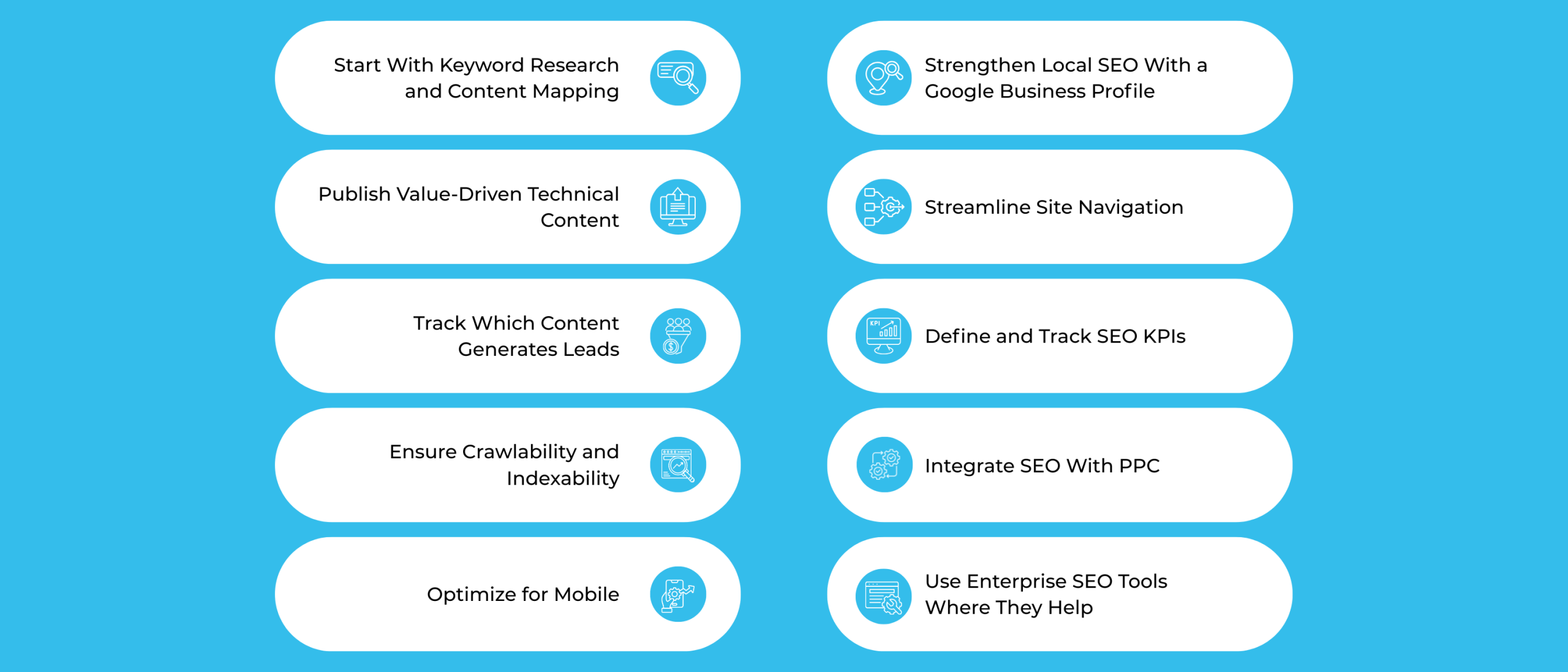
1. Start With Keyword Research and Content Mapping
First, identify the exact terms buyers use – product names, materials, processes, certifications, and locations. Then map each keyword to a dedicated page, so every important search has a clear destination on your site.
2. Publish Value-Driven Technical Content
Next, create content that answers real buying questions: product deep-dives, process explainers, spec guides, and application examples. Because industrial buyers search with constraints, detailed and accurate content earns both rankings and trust.
3. Track Which Content Generates Leads
Use analytics to connect content to outcomes – not just traffic, but quote requests, form fills, and calls. Consequently, you learn which pages actually drive the pipeline and can double down on what works.
4. Ensure Crawlability and Indexability
Search engines can only rank what they can read. Therefore, fix broken links, clean up your site structure, and free any spec sheets trapped in PDFs so your most valuable pages stay fully accessible.
5. Optimize for Mobile
Engineers and buyers increasingly research on phones and tablets. Since Google uses mobile-first indexing, a fast, responsive site is now essential for both rankings and user experience.
6. Strengthen Local SEO With a Google Business Profile
Many industrial searches are location-specific. So claim and complete your Google Business Profile, keep your name, address, and phone consistent everywhere, and gather reviews to build local credibility.
7. Streamline Site Navigation
A clear structure helps both buyers and search engines. Accordingly, keep key pages within a few clicks, use logical menus, and reduce crawl depth so nothing important gets buried.
8. Define and Track SEO KPIs
Decide what success looks like before you begin. Then monitor rankings, organic traffic, and conversions in tools such as Google Search Console and Google Analytics, and adjust based on the data.
9. Integrate SEO With PPC
SEO and paid search work better together. By sharing keyword and conversion data between them, you cover both long-term organic growth and immediate, high-intent visibility.
10. Use Enterprise SEO Tools Where They Help
As your program grows, platforms that automate audits, reporting, and prioritization save real time. As a result, your team can focus on strategy and content instead of manual checks.
SEO and AI Search: Getting Found in ChatGPT

Buyers increasingly research suppliers using AI tools like ChatGPT, Gemini, and Google’s AI Overviews – not just traditional search. Encouragingly, the fundamentals overlap: the same clear, structured, authoritative content that earns rankings is what AI engines pull from when they answer a buyer’s question. So to get cited, give them something quotable – a plain-language definition, direct answers to common questions, specific data with sources, and clean headings. Conversely, brochure-style pages with no substance get skipped. In short, optimizing for AI search (often called GEO or AEO) is mostly good SEO, done with extraction in mind.
How Arissa International Helps Manufacturers Get Found
Most manufacturing websites read like brochures – which is exactly why buyers scroll past them. As a digital marketing agency, Arissa International helps manufacturers turn their sites into search-and-sales assets, from technical fixes to content that ranks.
Our manufacturing SEO services include:
- Keyword research and content strategy built around buyer intent
- Technical SEO audits, site speed, and mobile optimization
- High-value product, capability, and process content
- Local SEO, analytics, and KPI reporting
Frequently Asked Questions (FAQs)
Usually 6 to 12 months for meaningful results, though early ranking gains often appear within 3 to 4 months. Long sales cycles make that patience worthwhile.
It targets lower search volumes but far higher value per visitor, focusing on technical, intent-driven terms rather than broad, high-traffic keywords.
Yes. The same fundamentals that earn search rankings – clear, structured, authoritative content – are what AI tools pull from when they answer buyer questions.
Often yes. In manufacturing, a keyword with only 50 searches a month can represent a five- or six-figure opportunity per buyer.
No. It complements them by making you visible earlier in the buying journey, before a buyer’s shortlist is already set.
It depends on your team’s time and expertise; many manufacturers partner with a specialist like Arissa International to handle technical SEO and content while they focus on production.