
What Is Healthcare Social Media Marketing?
Are patient stories worth the compliance risk? How often should we actually post? Is TikTok a real channel for healthcare? Why aren’t our followers turning into appointments?
If you’ve asked any of these questions, you’re not alone. Healthcare marketing teams — at hospitals, biotech companies, and private practices — run into the same friction the moment they try to scale their social media efforts. The platforms work differently. The rules are stricter. The playbook that works for SaaS or e-commerce doesn’t apply in most cases.
Healthcare social media marketing is the strategic use of platforms like LinkedIn, Facebook, Instagram, YouTube, X, and TikTok to educate audiences, build authority, and drive measurable growth — while maintaining the compliance, accuracy, and trust healthcare audiences expect.
The goal: turn social presence into a measurable channel for trust, visibility, and pipeline — without compromising HIPAA, FDA, or patient privacy.
At Arissa International, we help healthcare organizations build social programs that perform in regulated, trust-driven markets.
Why Does Social Media Marketing Matter in Healthcare?
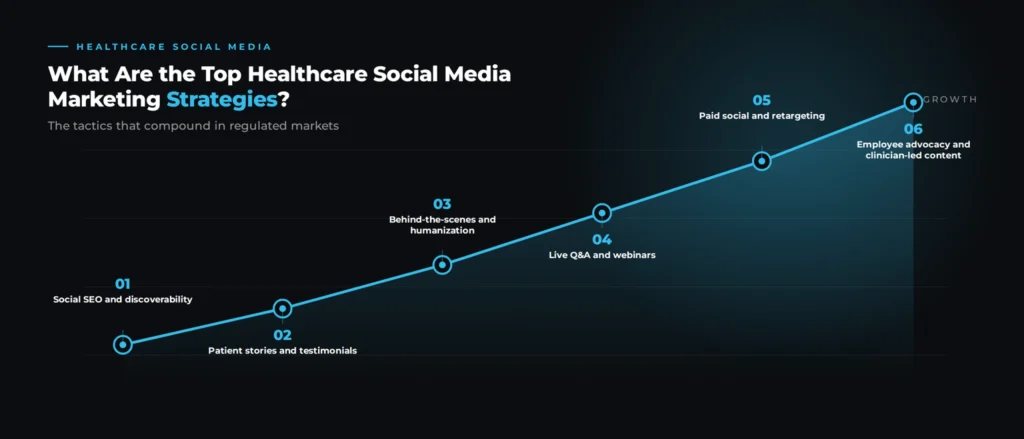
Social media isn’t just a connection platform anymore — it’s a strategic channel for healthcare organizations to build trust, educate audiences, and drive measurable growth. Four reasons it matters more in healthcare than in most other industries.
Brand Reputation
- Direct engagement positions your organization as a credible, patient-focused authority
- Clinical insights, team perspectives, and educational content humanize the brand and signal expertise
- Matters more in healthcare than any other industry — credibility decides whether patients, investors, or HCPs engage at all
Information Accuracy and Crisis Response
- During health crises, misinformation spreads faster than facts
- A strong social presence enables timely, accurate updates with an audience already in place
- Brands that build that audience in calm periods are the ones patients turn to in critical ones
Patient and Community Engagement
- Real-time, two-way conversation that traditional channels can’t match
- Patients ask questions, communities form around shared conditions, and supporters become advocates
- Brands that treat social as a conversation — not a broadcast — build loyalty that compounds over years
Pipeline Impact
- Social media isn’t just a brand channel — done well, it drives qualified inquiries, appointments, investor meetings, and KOL partnerships
- According to the Forbes Communication Council, most patients use social media to research health topics, and over half say these interactions influence their healthcare decisions
- Makes social one of the few top-of-funnel channels where engagement quality actually correlates with conversion
What Makes Healthcare Social Media Marketing Different?
Four structural realities shape every healthcare social strategy.
Regulation: HIPAA governs patient content, FDA constrains innovator communication, MLR review gates HCP-facing content, and the Sunshine Act shapes pharma–prescriber engagement.
Trust and accuracy: A single misleading post damages credibility for years. Healthcare audiences spot inaccuracies faster than any other industry.
Long, multi-stakeholder cycles: Viral posts rarely convert healthcare buyers. The body of work over months does.
Stakeholder diversity: Patients live on Facebook and Instagram; investors and BD on LinkedIn; HCPs across LinkedIn, X, and specialty forums.
Which Social Media Platforms Work Best for Healthcare?
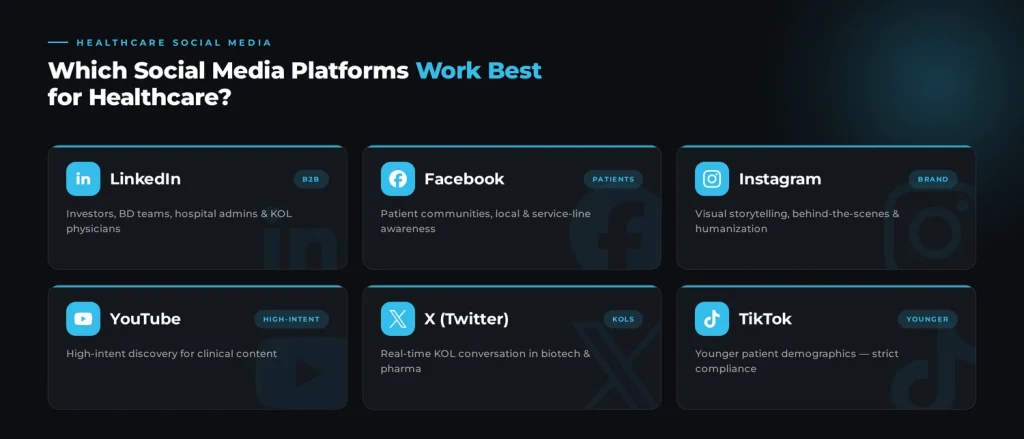
Each platform serves a different audience.
- LinkedIn — B2B; investors, BD teams, hospital administrators, KOL (Key Opinion Leader) physicians
- Facebook — patient communities, local engagement, service-line awareness
- Instagram — visual storytelling, behind-the-scenes, team humanization
- YouTube — high-intent discovery for clinical content
- X (Twitter) — real-time KOL conversation, especially biotech and pharma
- TikTok — younger patient demographics, with strict compliance
The right mix depends on your audience — not on what feels current.
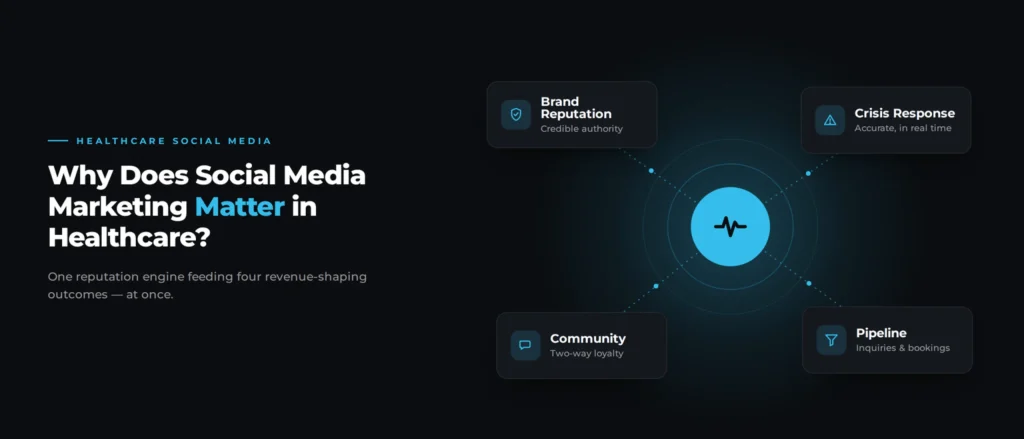
What Are the Top Healthcare Social Media Marketing Strategies?
Six approaches work consistently in healthcare. The right combination depends on audience and platform — but these are the strategies that move the needle.
Social SEO and discoverability.
- Optimizing content for in-platform search — YouTube search, Instagram Explore, LinkedIn discovery — not just feed engagement
- Most healthcare brands invest in Google SEO, but ignore that platform search drives the majority of social content discovery
- Use clinical and patient-language keywords in captions, hashtags, video titles, and alt text
- Particularly powerful on YouTube for long-tail clinical queries (“what to expect during X procedure”)
- Cross-platform consistency in naming, tagging, and metadata multiplies discoverability
Patient stories and testimonials.
- Builds trust faster than any other content type
- Requires strict written consent and HIPAA-aligned review
- Focus on experience and outcome, not identifiable details
- Done right: humanizes complex medical journeys and turns viewers into engaged prospects
- Done wrong: creates regulatory exposure that can take years to recover from
Behind-the-scenes and humanization.
- Facility tours, team introductions, day-in-the-life content, physician spotlights
- Converts passive followers into engaged communities
- For hospitals: reduces patient anxiety before procedures
- For practices: builds personal connection
- For biotech: founder-led content drives investor and KOL interest
Live Q&A and webinars.
- Patient Q&As, investor webinars on complex science, HCP-focused panels
- Real-time engagement positions your team as accessible experts
- Answers specific questions transparently — building trust, pre-recorded content can’t match
- Needs a clear protocol for questions that touch on individual medical advice
Paid social and retargeting.
- LinkedIn for funds and BD teams; Meta for patient demographics; specialty platforms for referring physicians
- Retargeting layers re-engage visitors who interacted with content or downloaded gated assets
- Meta and LinkedIn enforce specific healthcare ad policies, including restrictions on health-condition targeting
Employee advocacy and clinician-led content.
- Clinicians, researchers, and staff sharing branded content from their personal accounts
- In healthcare, clinician-led content consistently outperforms brand-led content for trust and reach
- Requires clear guidelines on what employees can and can’t share — critical under FDA promotional rules for biotech and pharma
- Platforms like LinkedIn Elevate or EveryoneSocial make this scalable
- Particularly powerful for biotech and pharma: clinician voices amplify scientific credibility in ways brand accounts can’t
These work only with the right operational practices.
What Are the Best Practices for Healthcare Social Media Marketing?
- Compliance review — every post through HIPAA/FDA/MLR review
- Platform-specific personas — distinct tracks per audience
- Posting consistency — cadence over volume
- Empathetic tone — compassion, not promotion
- Community management — same-day response, privacy-aware
- Crisis preparedness — protocols for misinformation and public health events
How Do You Measure Healthcare Social Media Success?
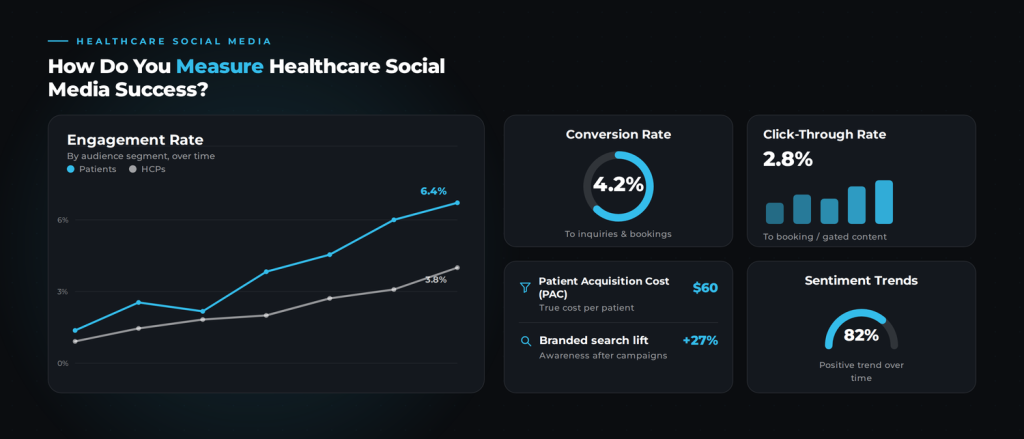
Followers and likes don’t reflect success. The metrics that matter:
- Engagement rate by audience segment
- Click-through rate to booking or gated content
- Conversion rate to inquiries or appointments
- Patient Acquisition Cost (PAC)
- Branded search lift after campaigns
- Sentiment trends
These separate teams that build trusted brands from those chasing vanity metrics.
What Are the Most Common Healthcare Social Media Mistakes?
- Same content across every platform
- Patient stories without documented consent
- Avoiding social entirely due to compliance fear
- Only promotional content
- Ignoring comments and DMs
- Measuring followers instead of outcomes
Most are fixable with the right systems — and that’s where we come in.
Frequently Asked Questions (FAQs)
Strategic use of LinkedIn, Facebook, Instagram, YouTube, X, and TikTok to educate audiences and drive measurable healthcare growth.
Yes. Any content with Protected Health Information must comply — including patient stories and DMs.
Only with documented consent and HIPAA-compliant review.
Depends on the audience. LinkedIn for B2B; Facebook and Instagram for patients; YouTube for education; X for KOLs.
Consistency matters more than frequency. Most perform well at 3–5 posts per week.
Yes, with restrictions. Meta and LinkedIn have specific rules; content must comply with HIPAA and the FDA.
Track engagement rate, CTR, conversion to inquiry, Patient Acquisition Cost, and branded search lift.
When in-house capacity can’t keep up, compliance slows campaigns, or you’re entering a new audience.
How Does Arissa International Approach Healthcare Social Media Marketing?
We build social programs at the intersection of compliance, credibility, and conversion — integrating AI-powered analytics, HIPAA-compliant workflows, paid social, KOL collaboration, and platform-specific strategy for patient, investor, and HCP audiences.
We don’t optimize for followers. We engineer programs that build trusted brands and generate qualified inquiries.
Book a discovery conversation or learn more about our Healthcare Marketing services.