

Manufacturing branding has become a competitive necessity rather than a marketing afterthought. Today, buyers, distributors, and procurement teams research manufacturers online long before they ever request a quote. As a result, the strength of your digital presence frequently decides whether your company makes the shortlist or gets scrolled past. In this guide, you will learn what industrial branding involves, why it matters now, and how to build a brand that earns trust and drives measurable growth.
Quick answer: A strong industrial brand identity helps manufacturers differentiate themselves from competitors, build trust with technical buyers, and shorten sales cycles by aligning visuals, messaging, and digital touchpoints into a single, consistent system.
What Is Manufacturing Branding?

Manufacturing branding is the practice of building a distinct, recognizable identity for a manufacturer that reaches beyond physical products. In other words, it covers the company’s values, visual identity, reputation, and the relationships it builds with customers, distributors, and partners.
Unlike consumer marketing, industrial branding addresses a longer and more rational buying cycle. Because procurement decisions often involve multiple stakeholders and significant budgets, trust and credibility carry even more weight than they do in retail.
A strong industrial brand usually includes:
- A clear value proposition that explains why the manufacturer is different
- Consistent visual identity — logo, colors, typography, and product imagery
- Messaging that speaks to engineers, buyers, and decision-makers
- Proof of expertise, such as certifications, case studies, and measurable results
- A fast, mobile-friendly website optimized for search and lead capture
Why Branding Matters for Modern Manufacturers
Buyers no longer rely on trade shows and cold calls alone. Instead, they compare suppliers, read reviews, and evaluate credibility online first. Consequently, manufacturers with weak digital branding lose visibility to competitors who present themselves more clearly — even when their products are superior.
Moreover, a recognizable brand reduces price sensitivity. When buyers trust a manufacturer, they focus less on the lowest quote and more on reliability, quality, and long-term partnership. Effective manufacturing branding, therefore, turns a commodity supplier into a recognized, preferred partner.
How to Build a Strong Industrial Brand: 5 Core Elements
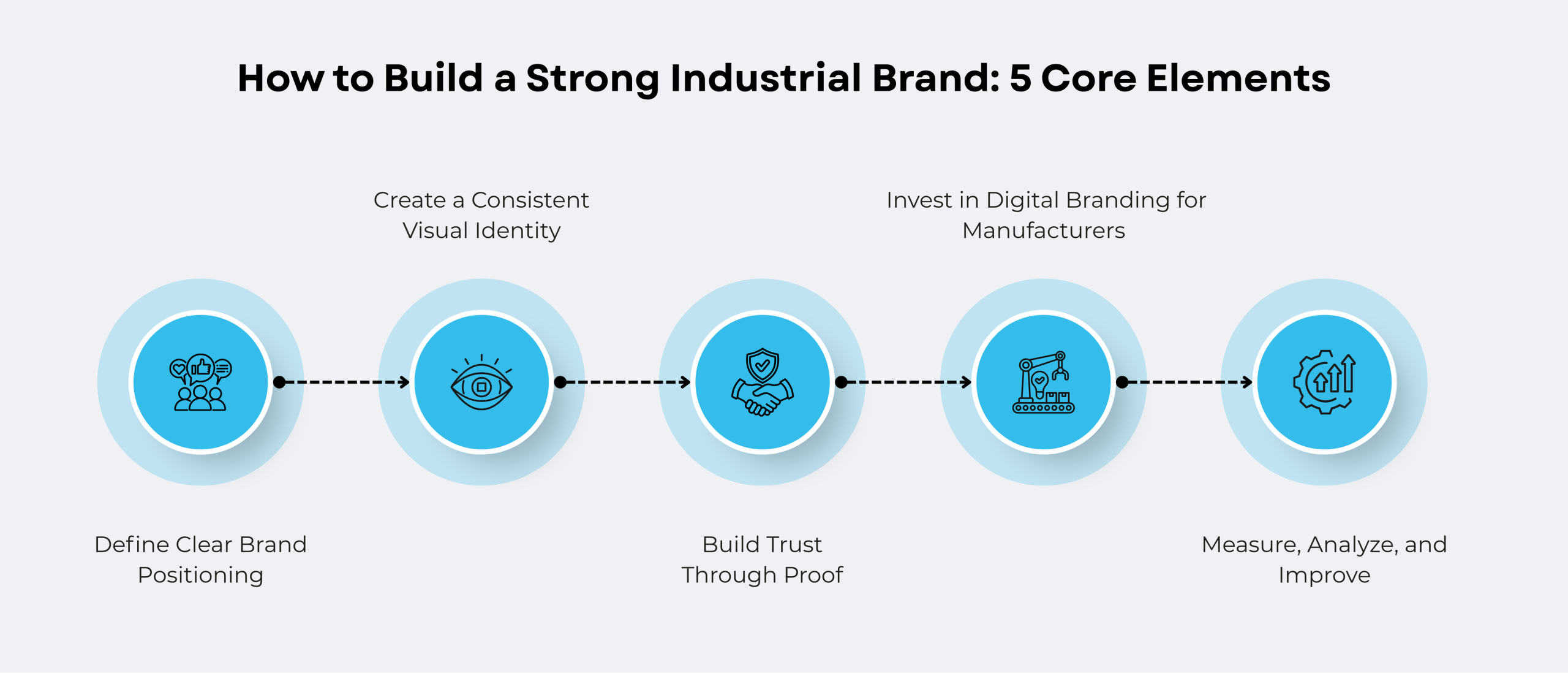
1. Define Clear Brand Positioning
First, decide what your company stands for and who it best serves. Strong brand positioning for manufacturers answers one question clearly: why should a buyer choose you over a cheaper alternative?
2. Create a Consistent Visual Identity
Next, align your logo, color palette, typography, and imagery across every channel. Consistency makes your brand instantly recognizable and signals professionalism to technical buyers.
3. Build Trust Through Proof
Because B2B buyers work hard to reduce risk before they commit, showcase certifications, client logos, case studies, and real performance data. This evidence builds credibility faster than marketing claims alone.
4. Invest in Digital Branding for Manufacturers
A modern website, an active LinkedIn presence, and search-optimized content all extend your reach. In addition, digital branding for manufacturers ensures buyers find consistent messaging wherever they research— including your conversion-focused landing pages.
5. Measure, Analyze, and Improve
Finally, track engagement, leads, and conversions. Data-driven insights reveal what works, so you can refine your branding strategies for manufacturing companies over time.
The Future of Industrial Branding
Industrial branding continues to move toward personalization, sustainability, and data. For example, AI-assisted research, interactive product demos, and predictive analytics increasingly shape how buyers discover and evaluate suppliers. Brands that adopt these tools early position themselves as industry leaders rather than followers.
How Arissa International Helps Manufacturers Grow
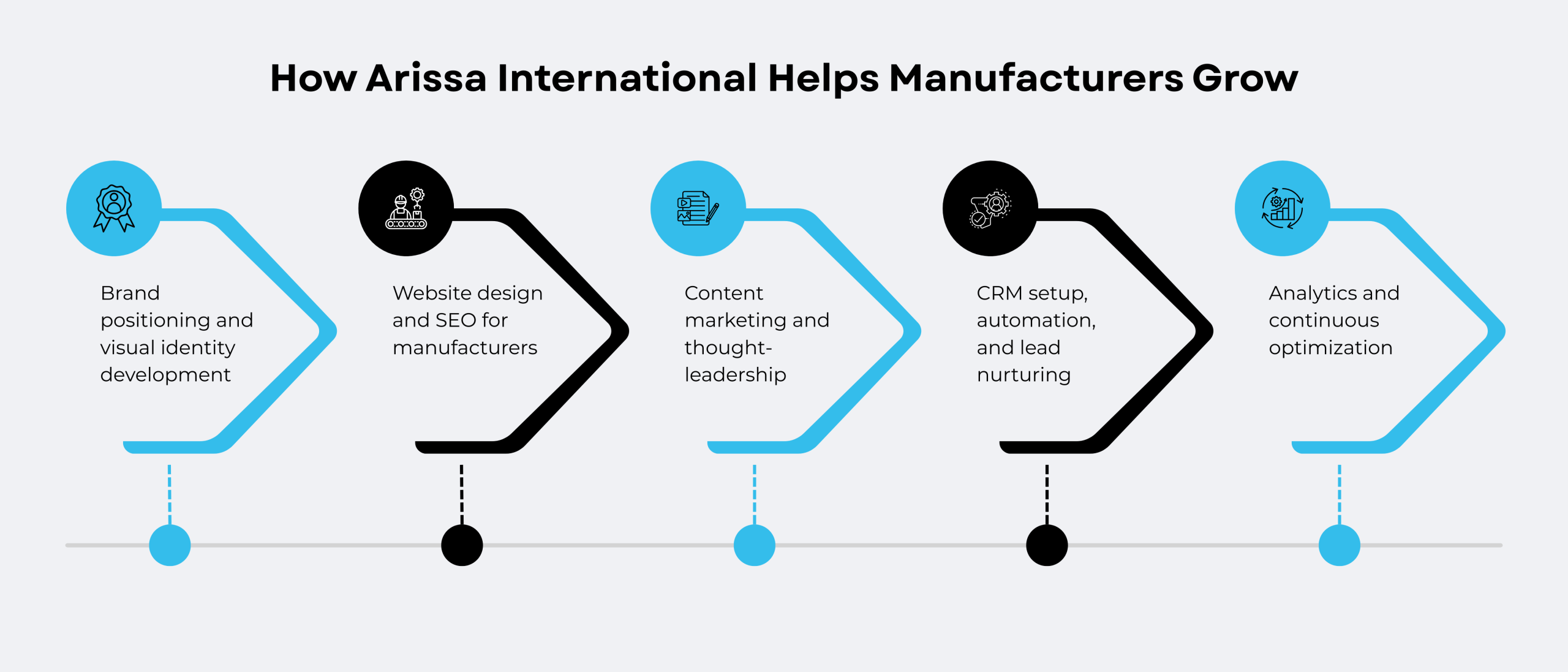
Arissa International helps manufacturers build clear, scalable industrial brands. As a digital marketing agency and HubSpot partner, we combine brand strategy, content, automation, and performance marketing into one connected system.
Our services for manufacturers include:
- Brand positioning and visual identity development
- Website design and SEO for manufacturers
- Content marketing and thought-leadership
- CRM setup, automation, and lead nurturing
- Analytics and continuous optimization
Frequently Asked Questions (FAQs)
By translating certifications, processes, and performance data into messaging that speaks directly to engineers, buyers, and decision-makers, rather than listing specifications alone. The strongest manufacturing brand stories pair that technical credibility with a clear point of view on why the company is different.
Clear brand positioning is the differentiator. Defining what the company stands for, who it best serves, and why a buyer should choose it over a cheaper alternative gives buyers a reason to decide on more than price or specifications alone.
Certifications, client logos, case studies, and real performance data. This evidence builds credibility faster than marketing claims alone, since B2B buyers work hard to reduce risk before they commit.
A consistent visual identity — logo, color palette, typography, and imagery — aligned across every channel makes a brand instantly recognizable and signals professionalism to technical buyers evaluating multiple suppliers.
Primarily through a fast, mobile-friendly website, an active LinkedIn presence, and search-optimized content, so buyers find consistent messaging wherever they research suppliers, including on conversion-focused landing pages.
By pairing storytelling with proof. Messaging aimed at engineers and procurement teams should stay grounded in certifications, case studies, and measurable results, so the story adds context to the technical credibility instead of replacing it.
Yes. Arissa International builds structured branding systems for manufacturers that combine brand positioning, visual identity development, content strategy, SEO-driven visibility, and CRM-driven lead nurturing into one connected system.