

Your customers don’t experience your business one channel at a time.
They may discover you through Google, see a social post, visit your website, download a resource, receive an email, and eventually speak with sales.
To them, that’s one relationship.
But when your marketing channels, customer data, and teams operate separately, every interaction can feel disconnected.
That’s the problem omnichannel marketing is designed to solve.
Quick answer: Omnichannel marketing connects a business’s marketing channels, customer data, messaging, and interactions so customers receive a consistent and relevant experience as they move between touchpoints.
The goal isn’t to be everywhere.
It’s to make the channels you already use work together.
What Is Omnichannel Marketing?
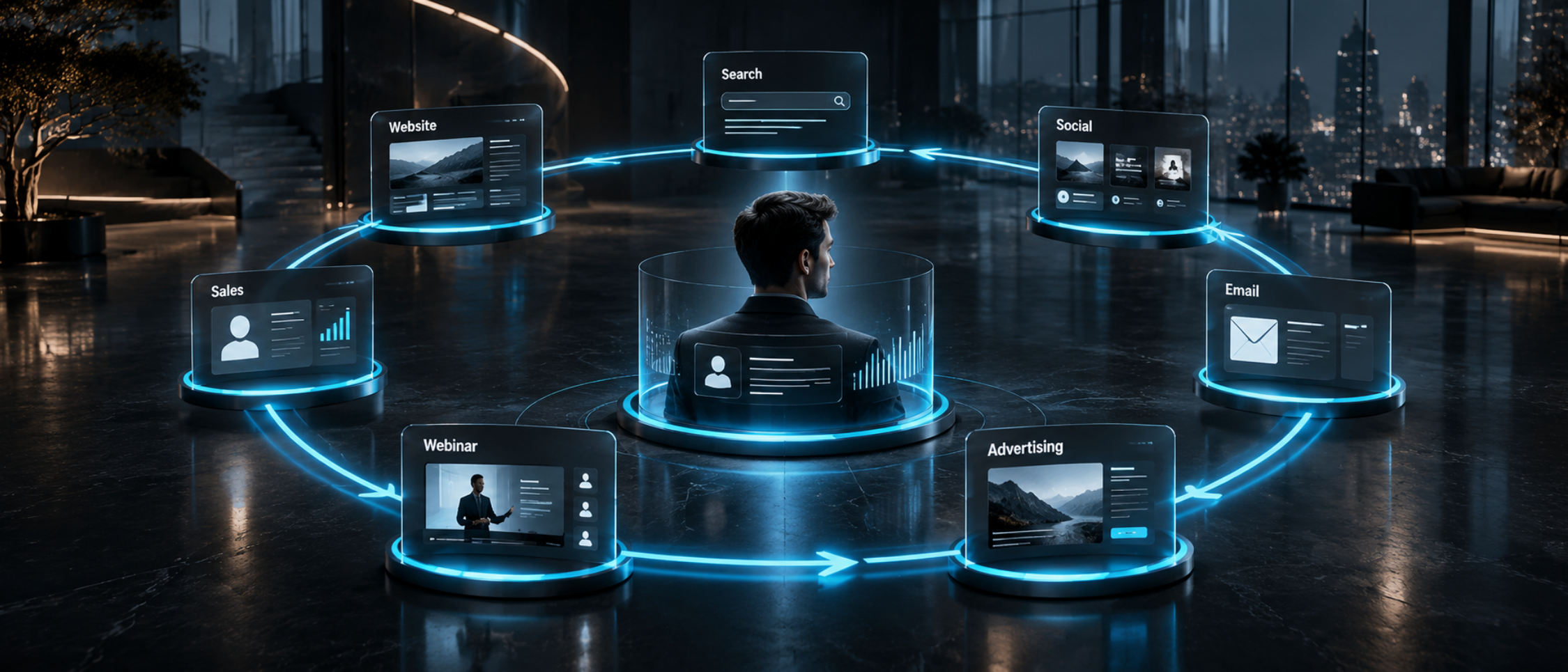
Omnichannel marketing is a strategy that connects multiple customer touchpoints around one consistent customer journey.
Instead of treating email, social media, search, paid advertising, your website, and sales outreach as separate activities, an omnichannel approach connects them through shared customer context.
For example, imagine a prospect who:
- Finds your company through Google.
- Visits a service page.
- Downloads an industry guide.
- Receives an educational email.
- Returns to your website.
- Attends a webinar.
- Requests a consultation.
- Speaks with sales.
In an omnichannel strategy, those interactions aren’t treated as eight unrelated events.
They contribute to one customer record and one evolving journey.
That means the next interaction can reflect what has already happened.
A prospect who has already downloaded a guide shouldn’t necessarily see another campaign asking them to download the same guide.
A person who has spoken with sales shouldn’t continue receiving the same introductory messaging as a brand-new lead.
A customer shouldn’t keep seeing acquisition campaigns for a product they’ve already purchased.
The defining idea behind omnichannel marketing is context.
Why Does Omnichannel Marketing Matter?
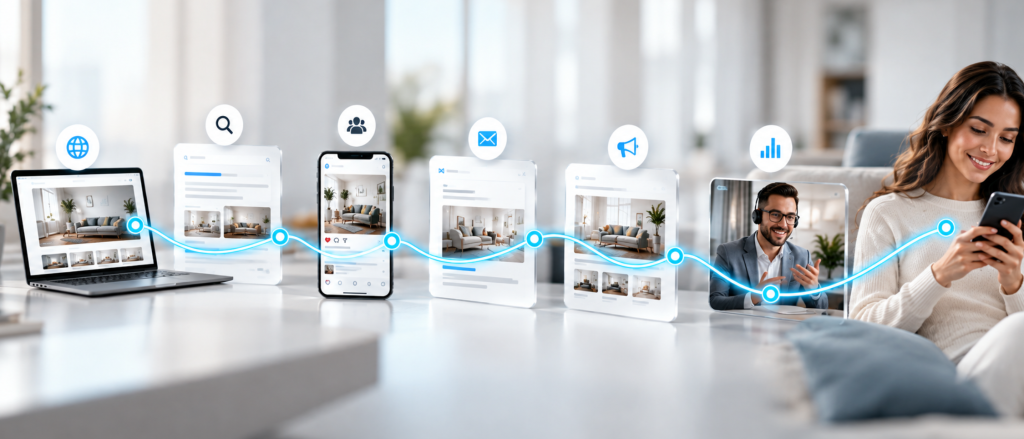
Customers now move between channels before making a decision.
They might search for information, compare providers, read reviews, consume content, interact with social media, visit websites, and speak with a sales representative before becoming a customer.
If each channel operates independently, the customer has to experience the gaps between your systems.
That can create problems such as:
- Repetitive communication
- Irrelevant advertising
- Inconsistent messaging
- Poor sales handoffs
- Fragmented customer data
- Missed buying signals
- Wasted marketing spend
- Difficulty understanding the complete customer journey
An omnichannel strategy helps address these issues by connecting interactions around the customer rather than around individual marketing channels.
The result can be a more consistent customer experience and better visibility for the teams managing that experience.
What Is the Difference Between Multichannel and Omnichannel Marketing?
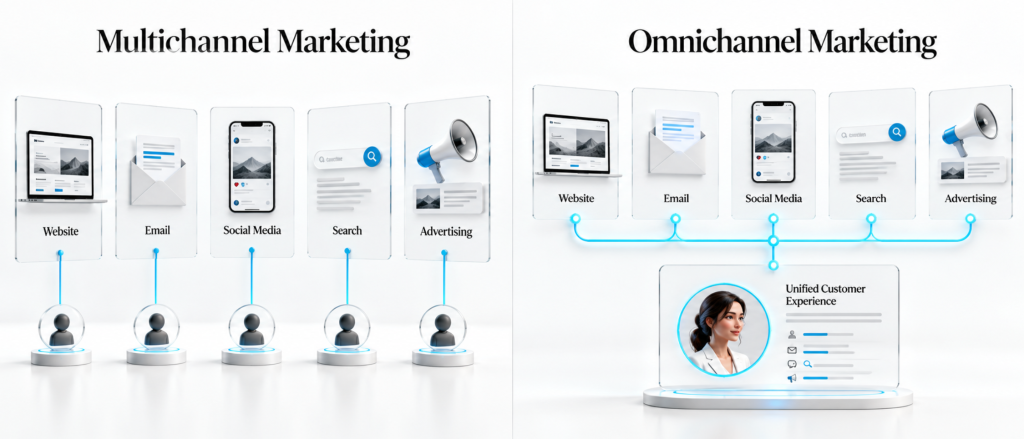
Multichannel marketing uses multiple channels. Omnichannel marketing connects those channels around the customer journey.
| Multichannel Marketing | Omnichannel Marketing |
|---|---|
| Uses multiple marketing channels | Connects multiple channels |
| Channels may operate independently | Channels share customer context |
| Campaigns are often managed separately | Campaigns contribute to one journey |
| Customer data may be fragmented | Customer data is connected where possible |
| Messaging can vary between channels | Messaging is coordinated |
| Focuses on channel presence | Focuses on customer experience |
For example, a company might use email, social media, paid advertising, and a website.
That’s multichannel.
If activity on those channels informs what the customer sees next—and those interactions are connected through CRM and marketing systems—that moves toward an omnichannel approach.
The difference isn’t how many channels you have. It’s how well those channels work together.
How Does Omnichannel Marketing Work?
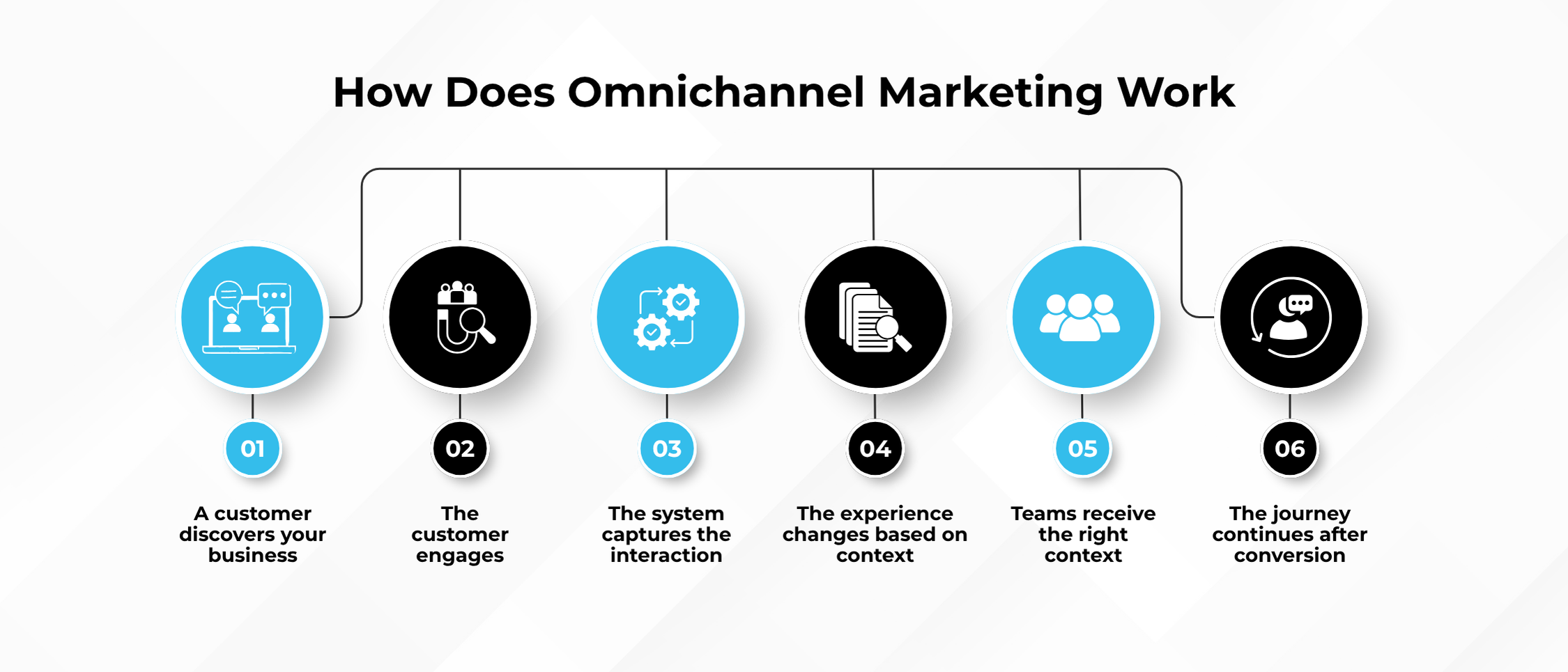
An omnichannel strategy generally connects four things:
Customer data + channels + messaging + journey logic
Here’s what that can look like in practice.
Step 1: A customer discovers your business
A prospect might find you through search, social media, paid advertising, content, a referral, or another source.
The first interaction creates an initial point of context.
Step 2: The customer engages
They may visit your website, download a resource, subscribe to email, attend an event, or interact with your content.
Each action can provide additional information about their interests.
Step 3: The system captures the interaction
CRM and marketing platforms can record relevant interactions and associate them with the appropriate contact or customer record.
This gives marketing and sales more visibility into what has already happened.
Step 4: The experience changes based on context
The next communication can reflect the customer’s behavior.
Someone interested in one service can receive content related to that area.
Someone who has already converted can move out of an acquisition journey.
Someone showing stronger intent can be routed toward a sales conversation.
Step 5: Teams receive the right context
When sales becomes involved, the representative can have visibility into relevant marketing activity.
The customer doesn’t have to explain their entire journey from the beginning.
Step 6: The journey continues after conversion
Omnichannel marketing isn’t only about acquiring customers.
The same connected approach can support onboarding, education, retention, cross-selling, customer communication, and long-term engagement.
The journey doesn’t have to be linear. It needs to be connected.
What Channels Should an Omnichannel Marketing Strategy Include?
There isn’t a universal list of channels every business needs.
The right mix depends on how your customers discover, evaluate, buy from, and interact with your business.
Common channels include:
Website
Your website is often where different marketing channels converge.
Search visitors, social visitors, paid traffic, email recipients, and referrals may all arrive there.
The website should support the customer’s current stage and intent rather than treating every visitor identically.
Email can connect directly with CRM information and customer behavior.
For example, someone who downloads a resource can receive relevant educational content rather than a generic promotional sequence.
Social Media
Social media can support awareness, engagement, education, and community building.
Its role should be connected to the wider customer journey rather than treated as a completely separate marketing activity.
Search
Search can introduce prospects to your business when they’re actively looking for information, solutions, or providers.
Search content can then connect with website experiences, lead capture, nurturing, and sales processes.
Paid Advertising
Paid campaigns can support acquisition, consideration, and remarketing.
Connecting advertising audiences with customer and CRM data can help prevent customers from receiving irrelevant acquisition campaigns.
Sales
Sales is part of the customer experience.
Marketing engagement can give sales useful context, while sales activity can also influence how marketing communicates with a prospect.
CRM
A CRM can serve as an important connective layer between these interactions.
It can help bring customer information, engagement history, lifecycle stages, and sales activity into a shared view.
What Role Does CRM Play in Omnichannel Marketing?
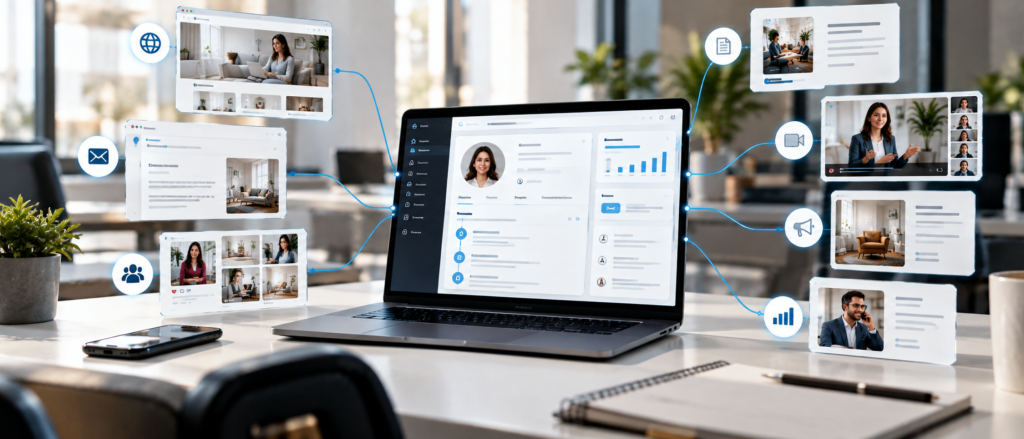
CRM helps omnichannel marketing by bringing customer information and interactions into a shared system that marketing and sales can use to understand the customer journey.
Without connected customer data, omnichannel marketing becomes difficult to execute.
Consider a prospect who has:
- Visited your website several times
- Downloaded two resources
- Attended a webinar
- Clicked several emails
- Viewed a service page
- Spoken with a sales representative
If those interactions are scattered across disconnected systems, no single team may have the complete picture.
A connected CRM environment can provide visibility into relevant information such as:
- Contact details
- Original source
- Website activity
- Content engagement
- Email activity
- Lifecycle stage
- Lead score
- Sales activity
- Customer status
The objective isn’t to collect every possible data point.
It’s to give the right teams enough context to make the next interaction more relevant.
How Do You Build an Omnichannel Marketing Strategy?
A practical omnichannel marketing strategy can be built in six stages.
1. Map the customer journey
Identify how customers typically move from discovery to consideration, conversion, and retention.
Ask:
- Where do customers first find us?
- What information do they need next?
- Which channels do they use?
- Where does sales become involved?
- What happens after conversion?
2. Identify the important touchpoints
You don’t need to connect every interaction.
Focus first on the touchpoints that have the greatest impact on the customer journey.
3. Audit your customer data
Find out where customer information currently lives.
Look for:
- Duplicate records
- Missing information
- Disconnected systems
- Inconsistent lifecycle stages
- Data that marketing and sales can’t easily access
4. Connect the right systems
Connect the CRM, marketing platforms, advertising tools, website, sales systems, and other relevant technologies where there is a clear business need.
The goal is useful integration—not integration for its own sake.
5. Build the journey logic
Define what should happen when customers take meaningful actions.
For example:
Content download → Relevant nurture → High-intent engagement → Sales notification
Or:
Purchase → Acquisition campaigns removed → Customer onboarding → Education → Retention
6. Measure and improve
Review what happens across the journey.
Look for:
- Conversion rates
- Customer acquisition cost
- Engagement
- Marketing-influenced opportunities
- Sales conversion
- Retention
- Revenue contribution
- Drop-off points
Then improve the parts of the journey that aren’t working.
How Can You Personalize Omnichannel Marketing Without Making It Complicated?
Personalization doesn’t mean creating a completely different campaign for every customer.
It starts with useful distinctions.
For example:
- New visitor vs. returning visitor
- Prospect vs. customer
- General interest vs. specific service interest
- Low engagement vs. high engagement
- New lead vs. sales-qualified opportunity
- Active customer vs. inactive customer
These distinctions can help determine what someone should see next.
The goal is simple:
Make the next interaction more relevant because you understand what happened before it.
That’s often more valuable than adding dozens of complicated personalization rules.
What Are the Common Omnichannel Marketing Challenges?
Omnichannel marketing can become complicated if the strategy isn’t clearly defined.
Disconnected data
If customer information lives in separate systems, teams may only see part of the journey.
Inconsistent messaging
Different teams may communicate different offers, positioning, or information.
Too many channels
Adding channels without a clear customer journey can create more work without improving the experience.
Excessive communication
A customer being reachable on five channels doesn’t mean they should receive five messages.
Poor segmentation
If every contact enters the same journey, the experience quickly becomes generic.
Technology-first implementation
Building integrations and workflows before understanding the customer journey can create unnecessary complexity.
Weak measurement
Looking at each channel independently can make it difficult to understand how the complete journey contributes to pipeline and revenue.
The answer isn’t always more technology. Often, it’s a clearer strategy.
How Do You Measure Omnichannel Marketing Performance?

Omnichannel performance should be measured across the customer journey rather than only by individual channel metrics.
Useful measures can include:
- Website conversion rate
- Lead conversion rate
- Cost per lead
- Customer acquisition cost
- Email engagement
- Campaign engagement
- Marketing-influenced opportunities
- Sales conversion rate
- Customer retention
- Revenue by campaign or source
- Time between journey stages
It’s also useful to ask cross-channel questions:
Do prospects who engage with multiple channels convert at a higher rate?
Which channels contribute to qualified opportunities?
Where do customers drop out of the journey?
Which campaigns influence revenue?
These questions provide a more complete picture than looking at clicks or impressions in isolation.
How Can HubSpot Support Omnichannel Marketing?
HubSpot can support an omnichannel marketing strategy by bringing CRM data together with marketing, sales, automation, content, reporting, and customer interactions.
Depending on the products and subscription tier being used, businesses can use HubSpot to support activities such as:
- Contact and company management
- Marketing automation
- Email marketing
- Forms and lead capture
- Segmentation
- Lead scoring
- Customer journeys
- Sales handoffs
- Campaign reporting
- Integrations with other business systems
The important point is that HubSpot is the technology layer, not the strategy itself.
Before building workflows or connecting systems, businesses still need to understand their customer journey and decide what experience they want to create.
How Arissa International Helps Build Omnichannel Marketing Strategies
An effective omnichannel strategy needs more than connected software.
It needs a clear journey, usable customer data, thoughtful automation, and alignment between marketing and sales.
As a HubSpot Gold Partner, Arissa International helps businesses bring those pieces together.
Our approach can include:
- Customer journey mapping. We identify the important stages, touchpoints, and transitions in your customer experience.
- HubSpot implementation. We configure CRM, marketing, automation, segmentation, and reporting around your business requirements.
- CRM and system integration. We connect relevant platforms so customer information can move where teams need it.
- Marketing automation. We create workflows that respond to meaningful customer actions.
- Segmentation and personalization. We help organize contacts into practical audiences based on their characteristics and behavior.
- Sales and marketing alignment. We establish clearer handoffs and shared visibility into customer activity.
- Reporting and optimization. We monitor the journey and identify opportunities to improve performance.
The objective isn’t to connect every possible tool.
It’s to create a system where each interaction adds context to the next one.
The Takeaway
Customers don’t think in channels.
They think in experiences.
They don’t separate the email they received from the website they visited, the advertisement they saw, or the conversation they had with sales.
It’s all part of the same relationship.
That’s why omnichannel marketing matters.
When your channels, customer data, messaging, and teams work together, you can create a more consistent experience while giving your teams better visibility into what customers actually need.
The goal isn’t simply to reach customers everywhere.
It’s to make every interaction feel like it belongs to the same conversation.
Frequently Asked Questions (FAQs)
Omnichannel marketing connects multiple marketing channels, customer data, messaging, and interactions around one customer journey. The goal is to provide a more consistent and relevant experience across touchpoints.
A prospect might discover a company through search, visit its website, download a guide, receive relevant email content, attend a webinar, and later speak with sales. In an omnichannel strategy, those interactions are connected so each stage can inform what happens next.
Multichannel marketing means a business uses multiple channels. Omnichannel marketing connects those channels around the customer journey so customer interactions and data can inform subsequent experiences.
Omnichannel marketing can reduce disconnected communication, improve customer context, support better coordination between marketing and sales, and create a more consistent experience across customer touchpoints.
Depending on the business, an omnichannel strategy may include websites, search, email, social media, paid advertising, content, events, sales outreach, customer service, and CRM systems.
A CRM isn’t the only requirement, but it can play an important role by connecting customer information and interactions and giving marketing and sales teams access to relevant context.
HubSpot can connect CRM data with marketing, sales, automation, content, reporting, and other customer interactions. Available capabilities depend on the HubSpot products and subscription tier being used.
Start by mapping the customer journey, identifying important touchpoints, auditing your customer data, connecting the systems that matter, defining journey logic, and measuring the results.
Yes. Arissa International can help with customer journey mapping, HubSpot implementation, CRM setup, integrations, marketing automation, segmentation, reporting, and optimization.