


Improving Lead Qualification and Engagement with an MQL Workflow
As lead volumes increase, managing engagement manually becomes inefficient and inconsistent. Businesses often struggle to identify which contacts are actively interested, prioritize follow-ups, and maintain visibility across the funnel.
Without structured systems, lead journeys become fragmented, making it difficult for sales teams to act at the right time. This creates a growing need for scalable, behavior-driven lead management systems.
About the Client
iPlanTables is a provider of wide-format touchscreen display workstations, managing a growing volume of inbound and outbound leads across multiple stages. Using Constant Contact CRM for contact management and communication, the team relied on manual processes for lead engagement and tracking.
Industry: Construction
Company Size: 11-50 employees
Location: United States
Tools Used

About the Client
iPlanTables is a provider of wide-format touchscreen display workstations, managing a growing volume of inbound and outbound leads across multiple stages. Using Constant Contact CRM for contact management and communication, the team relied on manual processes for lead engagement and tracking.
Industry: Construction
Company Size: 11-50 employees
Location: United States
Tools Used
Industry: Construction
Company Size: 11-50 employees
Location: United States
Tools Used
Overview: Aligning Lead Qualification with Structured Workflows
To address inefficiencies in lead qualification and engagement, a structured MQL workflow was implemented to introduce automation, segmentation, and lifecycle-based progression. This shifted lead management from a manual, reactive process to a more controlled and scalable system.
With support from Arissa International, the solution focused on improving how leads were tracked, nurtured, and qualified across stages. The goal was to create a workflow that ensured consistent engagement, clearer lead prioritization, and better alignment between marketing and sales teams.
The Challenge: Managing Lead Qualification Without Structured Workflows
Without a structured, behavior-driven system, lead management lacked consistency and clarity, making it difficult to prioritize engagement, track progress, and support timely sales actions.

Why the earlier approach failed
The previous system, Constant Contact, offered only basic email marketing capabilities with minimal automation. It lacked the ability to segment leads effectively or track lifecycle stages, resulting in a fragmented and reactive approach to lead management.

Manual Follow-Ups and Delayed Engagement
Follow-ups were handled manually, resulting in inconsistent, often delayed responses and reducing the likelihood of timely engagement with prospects.

No Visibility Into Lead Engagement
The team struggled to identify which contacts were actively engaging and which were inactive, as engagement tracking required manual effort.

Difficulty Tracking Conversions
There was no structured way to measure how many leads were progressing through the funnel or converting into opportunities.

Bulk Contacts Without Qualification
A large volume of contacts existed without segmentation, making it difficult to prioritize high-intent leads or filter out unresponsive ones.
The Solution: Implementing an MQL Workflow for Lead Qualification and Engagement
A structured MQL workflow was implemented to automate lead nurturing, improve segmentation, and align marketing activities with sales actions.


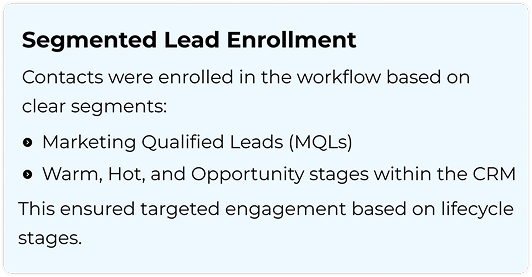
Segmented Lead Enrollment
Contacts were enrolled in the workflow based on clear segments:
- Marketing Qualified Leads (MQLs)
- Warm, Hot, and Opportunity stages within the CRM
This ensured targeted engagement based on lifecycle stages.
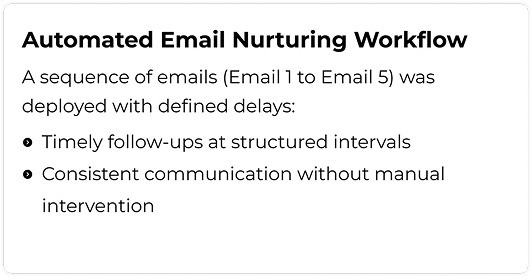
Automated Email Nurturing Workflow
A sequence of emails (Email 1 to Email 5) was deployed with defined delays:
- Timely follow-ups at structured intervals
- Consistent communication without manual intervention
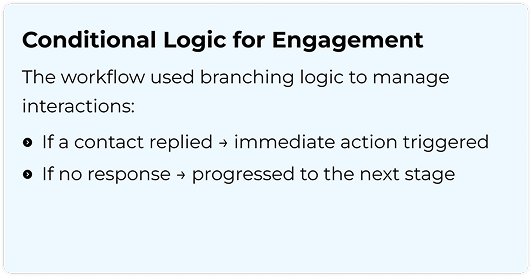
Conditional Logic for Engagement
The workflow used branching logic to manage interactions:
- If a contact replied → immediate action triggered
- If no response → progressed to the next stage
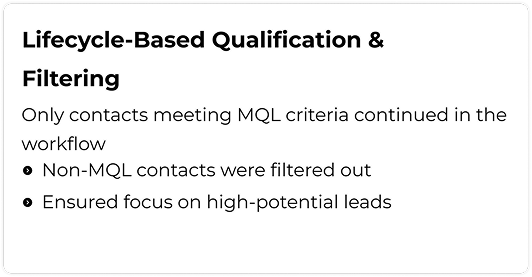
Lifecycle-Based Qualification & Filtering
Only contacts meeting MQL criteria continued in the workflow
- Non-MQL contacts were filtered out
- Ensured focus on high-potential leads
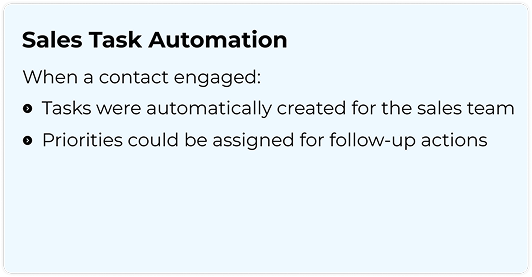
Sales Task Automation
When a contact engaged:
- Tasks were automatically created for the sales team
- Priorities could be assigned for follow-up actions
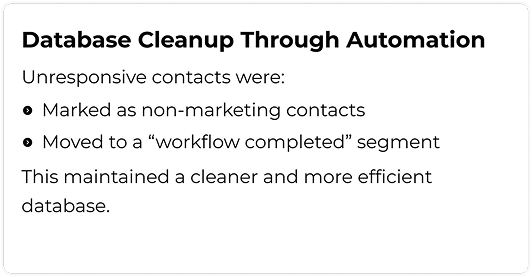
Database Cleanup Through Automation
Unresponsive contacts were:
- Marked as non-marketing contacts
- Moved to a “workflow completed” segment
This maintained a cleaner and more efficient database.
The Result: Improved Lead Tracking and Engagement Efficiency
The MQL workflow introduced clear improvements in how leads were managed and engaged.
The team experienced:
- Reduced dependency on manual tracking
- Improved visibility into engagement patterns
- Faster response times through automated tasks
- A more organized and segmented database
- Better control over lifecycle progression
These improvements created a more structured and predictable lead management process.
The Impact: Scalable Lead Management and Conversion Clarity
The workflow delivered long-term value by improving both operational efficiency and decision-making.
Key impacts included:
Improved lead qualification and visibility
Clear identification of high-intent leads and better funnel tracking.
Stronger marketing and sales alignment
Teams engaged leads at the right time based on real behavior.
Increased operational efficiency
Reduced manual workload and improved response consistency.
Scalable system for growth
Enabled the business to manage higher lead volumes without added complexity.
Overall, the implementation created a structured foundation for scalable lead nurturing and clearer conversion insights.
Conclusion: From Manual Lead Management to Scalable Qualification Systems
By implementing an MQL workflow, iPlanTables transitioned from a fragmented, manual process to a more automated and structured system. This improved engagement consistency, enhanced visibility into lead behavior, and enabled better alignment between marketing and sales.
Key Takeaways
- MQL workflows improve lead qualification through automation and segmentation
- Behavior-based engagement ensures timely follow-ups
- Automated workflows reduce manual effort and improve efficiency
- Structured systems support scalability and better tracking
Frequently Asked Questions (FAQs)
An MQL workflow is an automated process that nurtures leads through structured communication based on engagement and lifecycle stage.
It uses segmentation and behavioral triggers to identify which leads are ready for sales, reducing reliance on manual evaluation.
They lack conditional automation, making it difficult to adapt communication based on user behavior or engagement.
Inactive leads are automatically filtered out and moved into non-marketing segments to maintain a clean database.
Arissa International designs workflow-driven CRM systems tailored to real lead behavior and lifecycle stages, improving lead qualification, follow-ups, and alignment between marketing and sales.
Need help?
Your marketing success begins here. Contact us now.