

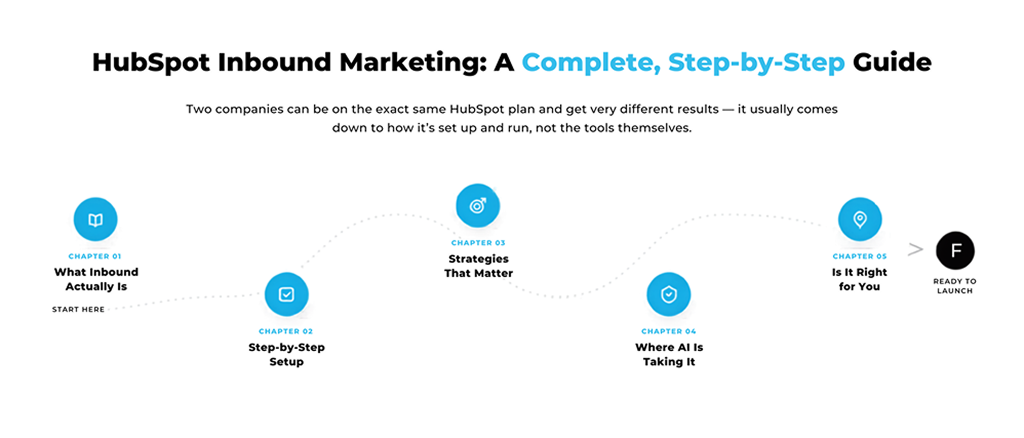
Two companies can be on the exact same HubSpot plan and get very different results. Why? It usually comes down to how it’s set up and run, not the tools themselves. This guide to HubSpot inbound marketing digs into exactly that: what inbound actually is on HubSpot, how to set it up step by step, the strategies that matter, where AI is taking it next, and an honest take on whether it’s a fit for your business.
What is HubSpot Inbound Marketing?
HubSpot inbound marketing is the practice of running the entire inbound methodology on HubSpot. Inbound is the approach: you earn a buyer’s attention with useful content instead of buying it with ads. Running it on HubSpot means handling every part of that journey in one place, from a visitor’s first blog read to the closed deal and the loyal customer afterward.
What makes that possible is a single source of truth. Your content, pages, forms, emails, automation, sales pipeline, and analytics all read from and write to the same contact record, so you run one connected system instead of stitching together separate tools.
The work moves through four stages:
- Attract is about earning the right visitors, the people actually looking for what you offer
- Engage is about turning those visitors into known contacts and building a relationship
- Convert is about moving qualified, interested leads into paying customers
- Delight is about keeping customers successful so they stay, buy again, and refer others
HubSpot frames these as a flywheel rather than a funnel. A funnel ends at the sale; a flywheel keeps turning, because satisfied customers power the next round of growth. The practical point is that the four stages aren’t separate efforts: each one feeds into the next.
Why HubSpot Inbound Marketing Works
The first reason is that it fits how people buy now. Buyers do their own homework, read reviews, and compare options long before they ever speak to a salesperson. Show up during that evaluation with something genuinely helpful, and you earn trust before you ask for anything in return.
The second reason is that it compounds. A paid ad stops the moment you stop funding it. A strong blog post or a well-built email sequence keeps drawing people in and converting them for months, so the work you did earlier keeps producing instead of resetting to zero. That makes inbound a steadier, more cost-effective way to grow than constantly renting attention.
How to Do Inbound Marketing in HubSpot: A Step-by-step Process
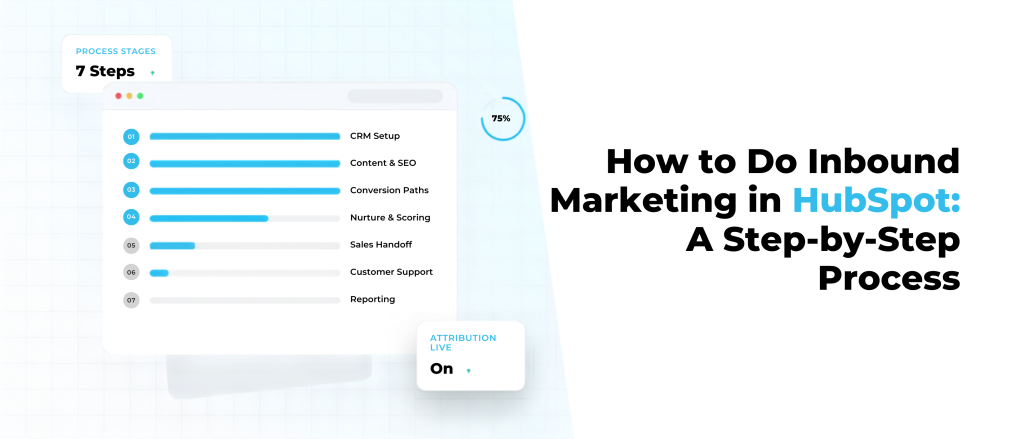
Here’s the step-by-step process we follow when we set up HubSpot inbound marketing for a client. Work through it in order, because each step depends on the one before it.
Step 1: Set up your CRM and define who you’re after – Import your contacts, configure your properties and deal pipeline, and get specific about your ideal customer and buyer personas. Everything that follows targets these people, so this is not the step to rush.
Step 2: Stand up your content and search presence – Plan blog content around the exact questions your buyers type into search, then use HubSpot’s built-in SEO recommendations and its Search Console connection to see what’s ranking and what needs work. Publish and schedule your social posts from the same place so distribution stays organized.
Step 3: Build your conversion paths – Give visitors a way to raise their hand. Create landing pages, forms, and calls to action that turn anonymous traffic into known contacts, and add live chat so people can reach you when they’re interested.
Step 4: Wire up nurture workflows and lead scoring – Most leads aren’t ready on day one. Segment your contacts, then build email workflows that fire automatically based on each person’s actions. Set up lead scoring based on engagement, on-site behavior, and fit, so the system can distinguish a curious browser from a serious buyer.
Step 5: Align sales and close the deal – Pass the leads that score as ready straight to sales. Because every interaction is logged against the contact automatically, a rep opens it and sees the full history, pages viewed, emails opened, forms filled, then picks up the conversation already knowing the context, which is what helps deals close.
Step 6: Support customers after the sale – Use service tools, a knowledge base, and timely follow-up to keep customers succeeding with what they bought. Customers who succeed renew, spend more, and refer others to you, which lowers the cost of winning the next sale.
Step 7: Set up your reporting – Build the dashboards and turn on attribution so you can see which content brings traffic, which pages convert, and which emails land. This is the visibility layer; without it, every later decision is a guess.
Inbound Marketing Strategies That Work in HubSpot
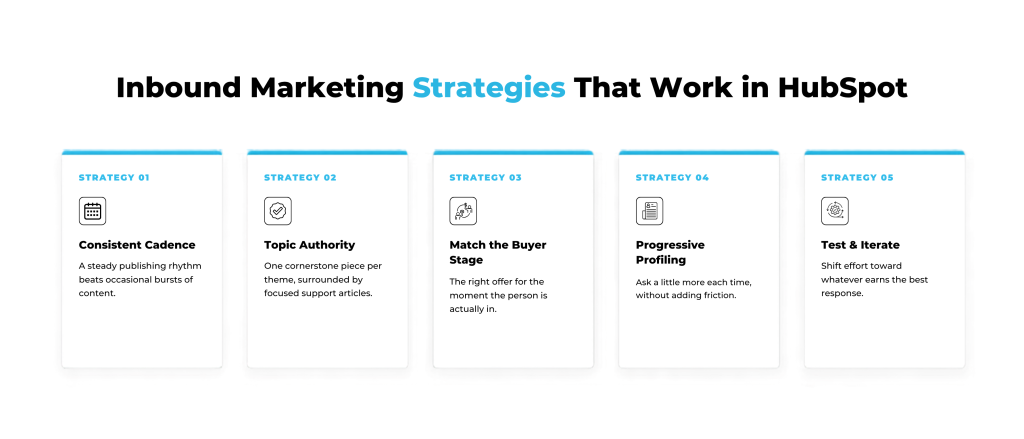
The process above builds the machine. These strategies are what make it actually produce, and none of them is a setup task; they’re the judgment calls you make once it’s running.
Commit to a consistent cadence: Inbound rewards regularity far more than intensity. A steady rhythm of publishing beats an occasional burst followed by silence, because search engines and audiences both reward showing up reliably.
Build authority around topics, not single posts: Pick the themes you want to be found for, write one thorough cornerstone piece on each, and surround it with focused articles that link back to it. Depth on a topic earns rankings and trust that scattered one-off posts never will.
Match what you offer to where the buyer is: Someone just discovering a problem wants a short guide, not a sales demo. Decide which resource belongs at the early, middle, and late stages of the journey, so every offer fits the moment the person is actually in.
Ask for information gradually: Instead of one long form that scares people off, use progressive profiling to request just a little more each time a contact comes back. Your understanding of them deepens visit by visit, without ever adding friction.
Run experiments and follow the results: Test your highest-traffic headlines, subject lines, and calls to action, then shift effort toward whatever earns the best response. Small, repeated improvements on your busiest assets add up to a meaningful gain over time.
How AI is Changing Inbound (and What It Means for You)
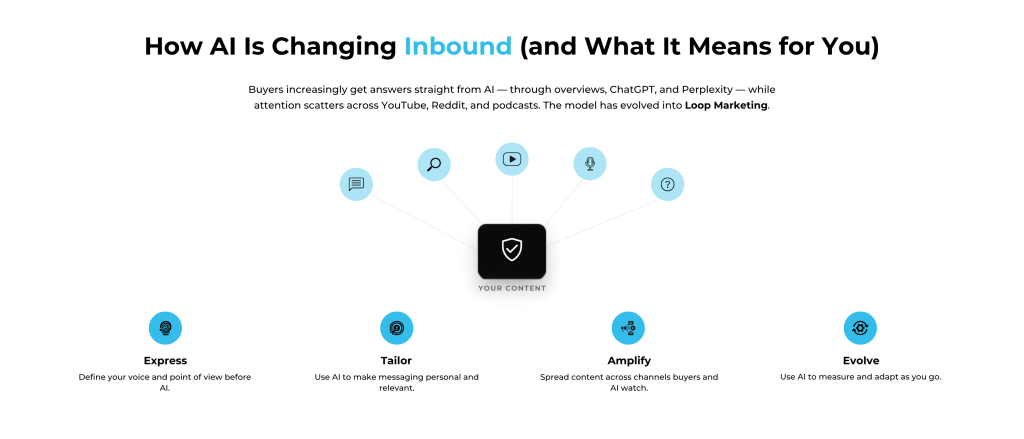
Here’s the shift worth your attention: buyers increasingly get answers straight from AI, through AI overviews in search and assistants like ChatGPT and Perplexity, often without clicking through to a website at all. Meanwhile, their attention is scattered across YouTube, Reddit, podcasts, and platforms that barely existed not long ago. The old assumption that a ranked blog post automatically earns the click is weakening.
The principles of inbound haven’t changed; you still educate, create value, and build trust. But the operating model has evolved past the funnel and the flywheel into what HubSpot now calls Loop Marketing. It’s a cyclical, self-improving take on inbound built for the AI era, and it runs in four stages: Express, where you define your voice and point of view before bringing in AI; Tailor, where you use AI to make messaging personal and relevant; Amplify, where you spread content across the channels buyers and AI both look at; and Evolve, where you use AI to measure and adapt as you go.
In practice, this adds two habits on top of everything above. Optimize to be the source AI engines cite, not only to rank in a list of links. And show up across the channels where attention actually lives, rather than waiting for people to find your site.
Is HubSpot Inbound Right for You?
Inbound suits some businesses far better than others, and it’s worth being honest about that before you invest. It pays off most for considered purchases, the kind people weigh over time, and when you’re ready to commit for the long haul rather than expecting a quick spike.
It can also be underused. If your sales cycle is very simple, a quick purchase nobody deliberates over, or your digital presence is still thin, a full inbound platform may be more than you need right now. In that case, it’s often smarter to close those gaps first, then grow into the platform as your needs catch up.
How Arissa International Builds and Runs Your Inbound Engine
This is the work we do every day. As a HubSpot Gold Solutions Partner, Arissa International sets inbound up so the stages connect from the start, then keeps it running as you grow.
We handle the build: configuring your HubSpot Marketing Hub, mapping it to the way your buyers actually move, and setting up each stage so it’s ready to run. After that, we keep it tuned because inbound performs best when someone owns it day-to-day.
Already on HubSpot, but it feels like a pile of disconnected tactics? We start with an audit of where the breaks are and what to fix first. Starting fresh? We build it right the first time, then keep tuning it through our managed services.
The Bottom Line
HubSpot inbound marketing rewards the businesses that treat it as a system to run, not a campaign to launch. Set it up properly and give it the attention it needs, and it stops being one more tool you pay for and becomes the part of the business that quietly drives growth. That’s the difference between doing inbound and getting paid for it.
Frequently Asked Questions (FAQs)
You can start attracting visitors and capturing leads on the free and starter tools. Multi-step automation, lead scoring, and deeper personalization are available on the Professional plans, so your tier depends on how much you plan to automate.
Yes. HubSpot integrates with a wide range of apps through its marketplace, so your email, analytics, and other systems can feed the same CRM instead of living in silos.
It builds gradually rather than spiking. Early signals like traffic and form fills can appear fairly quickly, while search rankings and pipeline impact develop over a longer, sustained effort.
It’s especially strong for B2B, where deals involve several people and unfold over months. Helpful content and steady follow-up keep you in front of every stakeholder until the timing is right.
Yes. As a HubSpot Gold Solutions Partner, we build, connect, and run inbound for clients, from setup and automation through ongoing measurement and tuning.