

Choosing between Marketo vs HubSpot is one of the biggest decisions a marketing team can make. Both are leading marketing automation platforms, but they are built for very different kinds of businesses. As a result, picking the wrong one can cost you months of setup and thousands in wasted budget. In this guide, we compare the two across pricing, ease of use, features, integrations, and best-fit use cases — so you can choose with confidence.
Quick answer: HubSpot is best for small and mid-sized teams that want an easy, all-in-one CRM and marketing platform. Marketo (Adobe Marketo Engage) is best suited for enterprises with complex workflows, advanced lead scoring, and a dedicated marketing operations team.
What Are Marketo and HubSpot?
What Is Marketo?
Marketo — now Adobe Marketo Engage — is an enterprise marketing automation platform built for complex B2B marketing. It specializes in advanced lead management, scoring, segmentation, and account-based marketing, and it usually pairs with a CRM such as Salesforce. Adobe acquired Marketo in 2018.
What Is HubSpot?
HubSpot is a CRM-first, all-in-one customer platform that unifies marketing, sales, service, and content into a single system. Founded in 2006, it is known for ease of use and a built-in CRM, which makes it especially popular with small and mid-sized businesses that want to launch quickly.
Marketo vs HubSpot at a Glance
| Factor | Marketo (Adobe Marketo Engage) | HubSpot |
|---|---|---|
| Best for | Enterprise B2B with complex workflows | SMBs to mid-market want all-in-one |
| Pricing model | Quote-based, enterprise-focused; paid implementation | Transparent published tiers + a free CRM |
| Ease of use | Steep; needs marketing-ops expertise | Intuitive; teams are productive in days |
| Setup time | Weeks to months | Days to weeks |
| CRM | No native CRM; pairs best with Salesforce | Built-in, native CRM |
| Automation & ABM | Advanced lead scoring, attribution and deep ABM | Strong, simpler multi-channel automation |
Pricing and Cost of Ownership
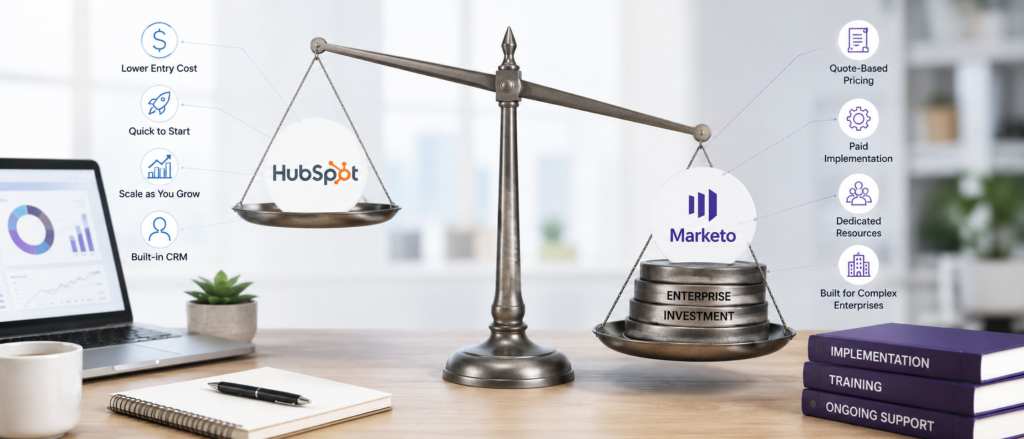
HubSpot uses transparent, published pricing. It offers a free CRM and tiered Marketing Hub plans, so teams can start small and scale as they grow.
Marketo, by contrast, uses quote-based pricing designed for enterprise budgets and usually requires paid implementation before launch. Because of this, the Marketo vs HubSpot cost difference is significant — HubSpot typically has a lower entry cost and faster time-to-value, while Marketo is a larger overall investment that assumes dedicated resources.
Ease of Use
HubSpot is famous for its usability. Most teams launch their first campaigns within days, thanks to an intuitive interface and HubSpot Academy’s free training.
Marketo, however, is more powerful but more complex. It usually requires weeks or months of setup and at least one dedicated marketing-operations specialist. Therefore, teams without technical resources often find HubSpot far faster to adopt.
Features and Capabilities
Both platforms cover the essentials — email, automation, lead nurturing, segmentation, and analytics. The difference lies in depth.
Marketo goes deeper to meet enterprise needs: advanced lead scoring, multi-touch revenue attribution, sophisticated account-based marketing (ABM), and highly customizable, program-based workflows. HubSpot, meanwhile, wins on breadth — it unifies marketing, sales, service, content, and CRM on a single platform, which keeps everything connected without extra integration work.
Integrations and CRM
This is where strategy matters most. HubSpot is CRM-first, so its marketing tools sync natively with its built-in CRM. Marketo, on the other hand, has no native CRM and performs best when paired with Salesforce as the system of record.
Consequently, if you want one unified system, HubSpot simplifies the stack. If Salesforce is already your core CRM and you have an ops team, Marketo can be a strong automation engine on top of it.
Marketo vs HubSpot: Which Should You Choose?
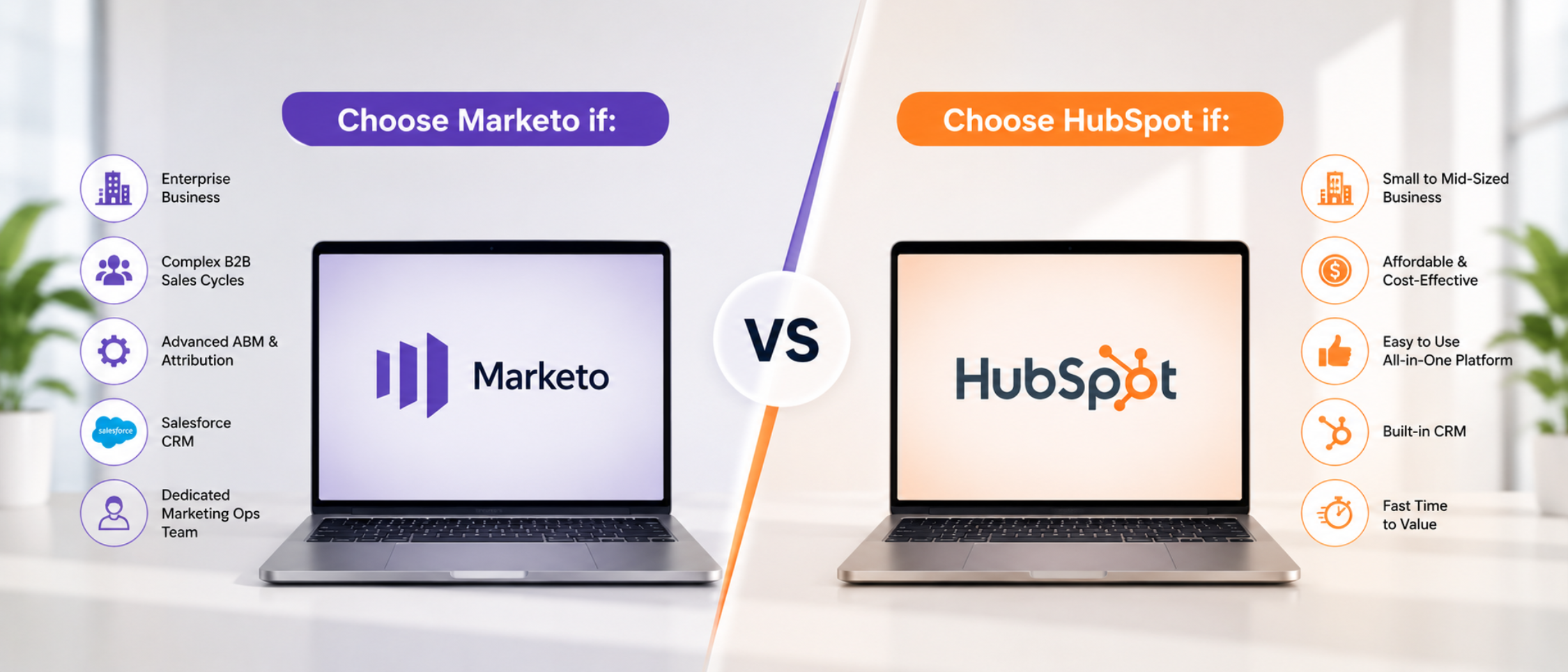
There is no single winner — only the right fit. Ultimately, the decision comes down to your team size, your CRM strategy, and your budget.
- Choose HubSpot if you are a small or mid-sized business that wants an affordable, easy, all-in-one platform with a built-in CRM and fast time to value.
- Choose Marketo if you are an enterprise with complex B2B sales cycles, dedicated marketing-ops staff, Salesforce as your CRM, and a need for advanced ABM and attribution.
How Arissa International Helps You Decide
Choosing the platform is only half the battle — implementing it well is what drives results. As a HubSpot partner and digital marketing agency, Arissa International helps businesses select, set up, and get real value from the right platform.
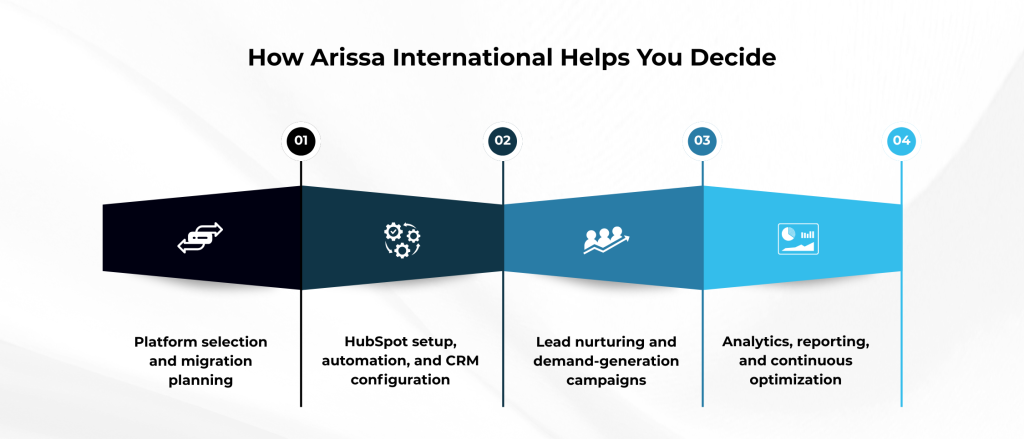
Our services include:
- Platform selection and migration planning
- HubSpot setup, automation, and CRM configuration
- Lead nurturing and demand-generation campaigns
- Analytics, reporting, and continuous optimization
Frequently Asked Questions (FAQs)
Yes. Marketo is now Adobe Marketo Engage — Adobe acquired it in 2018, and it sits within Adobe’s enterprise marketing stack.
Yes. HubSpot offers a native Salesforce integration, though many teams simply use HubSpot’s own built-in CRM instead.
You can, but most teams choose one. Running both adds cost and complexity, so it’s usually only worth it in large, multi-team setups.
Migration is where the Marketo vs HubSpot decision becomes real — it’s more than a data move. Most teams use a partner like Arissa International to rebuild workflows and scoring cleanly.
HubSpot provides HubSpot Academy and broad self-serve resources; Marketo offers its Marketing Nation community plus consultant-led onboarding.
Both are strong. HubSpot is simpler for everyday campaigns, while Marketo allows deeper, more customizable automation for complex programs.