

A new lead isn’t necessarily a sales-ready lead.
Someone may download a guide, request information, attend a webinar, submit a form, or visit your website several times without being ready to speak with sales. The challenge is staying relevant during that gap without asking your sales team to manually follow up with every prospect.
That’s where automated lead nurturing comes in.
What Is Automated Lead Nurturing?

Automated lead nurturing uses CRM data, segmentation, lead scoring, and automated workflows to keep prospects engaged with relevant follow-up based on their actions, interests, and stage in the buying journey.
Instead of treating every new contact the same way, an automated nurturing strategy responds to what each prospect does.
A prospect who downloads a beginner’s guide may receive educational content. Someone who repeatedly visits a pricing page may receive more product-focused information. A lead showing strong buying signals can be routed to sales at the right time.
The goal isn’t simply to send more emails.
It’s to make sure the right message reaches the right prospect at the right stage, without relying entirely on manual follow-up.
Why Good Leads Go Quiet
Not every lead is ready to buy when they first enter your CRM.
A prospect might be:
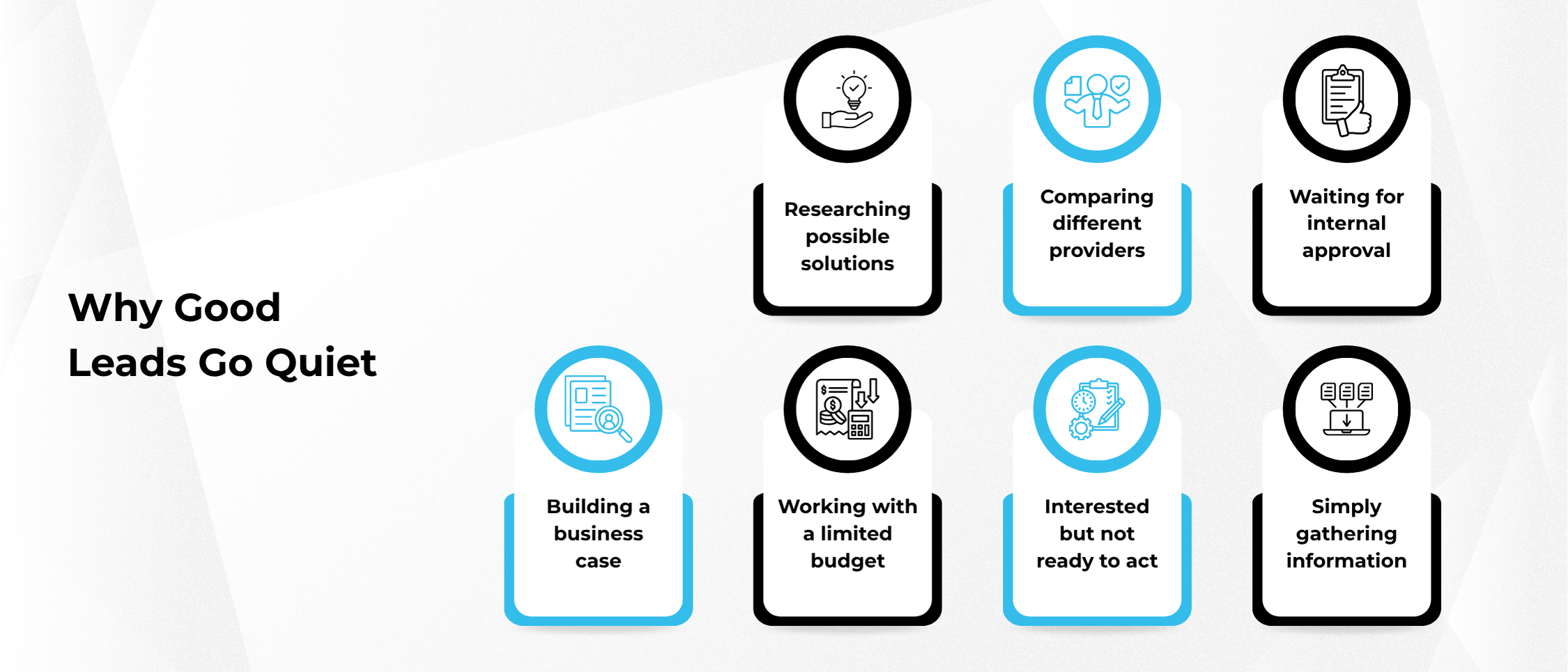
- Researching possible solutions
- Comparing different providers
- Waiting for internal approval
- Building a business case
- Working with a limited budget
- Interested but not ready to act
- Simply gathering information
If your only follow-up is a sales call or a generic email, the prospect may disengage.
This is where nurturing creates value. Instead of pushing every contact toward an immediate sales conversation, you can continue providing useful information while monitoring their engagement.
The prospect gets a more relevant experience, while your team gets better visibility into who is becoming sales-ready.
How Does Automated Lead Nurturing Work?
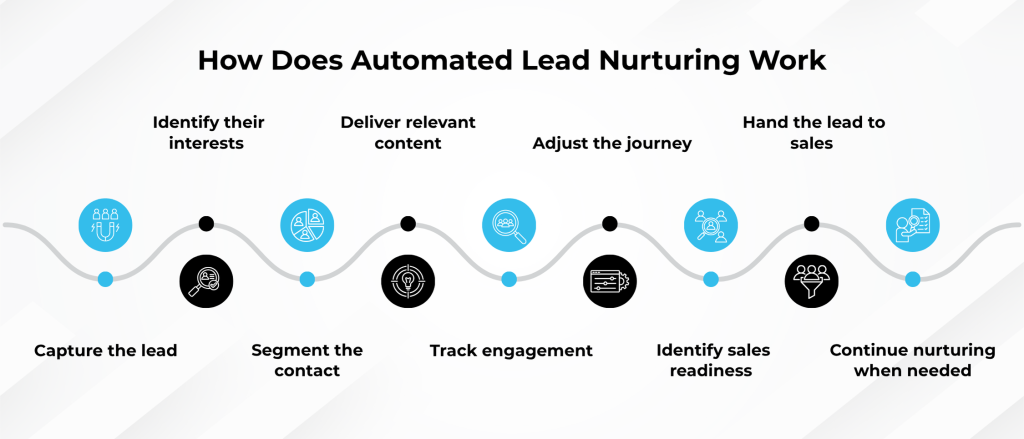
Automated lead nurturing typically follows a sequence of data, behavior, and workflow decisions.
1. Capture the lead
A prospect enters your CRM through a form submission, campaign, content download, event, referral, chat interaction, or another source.
2. Identify their interests
The system uses information such as the content they downloaded, pages they viewed, forms they submitted, or services they explored to understand what they may be interested in.
3. Segment the contact
Contacts can be grouped based on characteristics such as industry, company size, lifecycle stage, interests, location, or engagement level.
Segmentation means dividing contacts into meaningful groups so they can receive more relevant communication.
4. Deliver relevant content
Automated workflows can send educational resources, case studies, guides, emails, or other content based on the prospect’s needs and stage.
5. Track engagement
The system monitors signals such as email clicks and replies, website activity, content downloads, form submissions, and other interactions.
6. Adjust the journey
The prospect’s behavior can determine what happens next.
For example, someone who engages with several educational resources may move toward more product-focused content. Someone who becomes inactive may enter a different re-engagement workflow.
7. Identify sales readiness
Lead scoring assigns values to contacts based on characteristics and behavior. A prospect who demonstrates stronger engagement and buying signals can gradually become more sales-ready.
8. Hand the lead to sales
When a prospect reaches defined qualification criteria, the workflow can notify or route the contact to sales.
9. Continue nurturing when needed
Not every lead that reaches sales is ready to buy. If the timing isn’t right, the prospect can return to an appropriate nurturing journey rather than disappearing from the pipeline.
This creates a continuous path between marketing engagement and sales follow-up.
What Happens Between First Interest and Sales Readiness?
The journey from first interaction to sales conversation rarely happens in one step.
A typical path might look like this:
First interaction → Content engagement → Repeat visits → Increased engagement → Lead scoring → Sales-ready signal → Sales handoff
For example, imagine a prospect downloads an industry guide.
They may then:
- Open a follow-up email
- Read a related article
- Visit a service page
- Download a case study
- Return to the website
- Submit a consultation form
Each action provides additional context.
Instead of treating these interactions as isolated events, an automated nurturing system can connect them and help your team understand where the prospect is in the buying journey.
What Signals Should an Automated Lead Nurturing System Track?
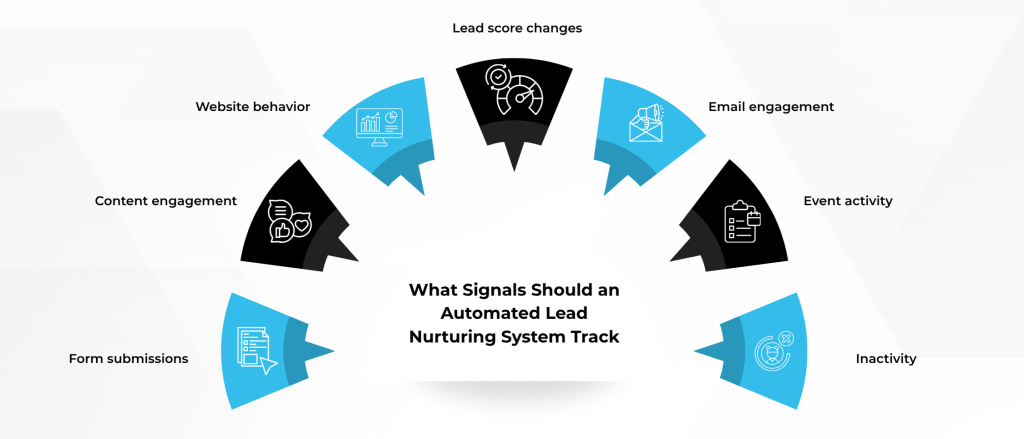
Effective nurturing depends on recognizing meaningful signals.
Depending on your business and CRM setup, these may include:
Form submissions
A form submission can reveal what a prospect is interested in and what action they are willing to take.
Content engagement
Downloads, resource views, webinar registrations, and other content interactions can indicate growing interest.
Website behavior
Repeated visits to specific pages can provide useful context, particularly when prospects visit service, product, pricing, or case-study pages.
Lead score changes
A rising lead score can indicate that a contact is becoming more engaged or showing stronger buying signals.
Email engagement
Clicks, replies, and other engagement signals can help determine whether the current nurturing path is relevant.
Event activity
Webinars, events, workshops, and other interactions can create important signals about a prospect’s interests and intent.
Inactivity
Lack of engagement is also a signal.
A prospect who stops interacting may need a different message, a longer nurturing cycle, or a re-engagement campaign.
The important point is that no single signal should determine sales readiness on its own. Strong nurturing combines multiple data points to create a more complete picture.
What Should You Automate in a Lead Nurturing Strategy?
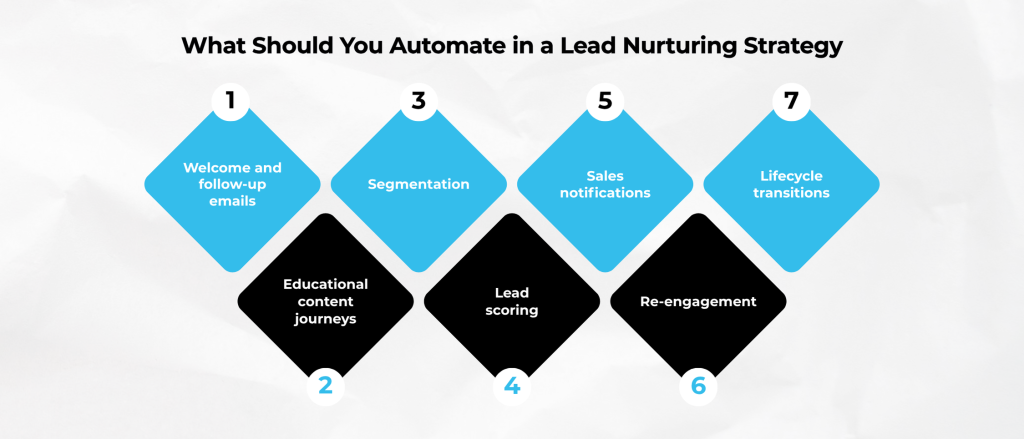
Not every part of lead nurturing needs to be automated.
The best candidates are repetitive activities that follow clear rules.
Welcome and follow-up emails
When someone submits a form or downloads a resource, automation can trigger an immediate response and continue the conversation.
Educational content journeys
Contacts can receive content that matches their interests and gradually moves from educational topics toward solution-oriented information.
Segmentation
New contacts can automatically enter the appropriate audience based on their attributes, source, behavior, or lifecycle stage.
Lead scoring
A lead score can change as prospects engage with content, visit important pages, submit forms, or demonstrate other defined behaviors.
Sales notifications
When a contact reaches a defined threshold, sales can receive a notification with relevant context about the prospect’s activity.
Re-engagement
Contacts who become inactive can enter a separate workflow designed to bring them back into the conversation.
Lifecycle transitions
Automation can help update lifecycle stages as contacts move through the customer journey, reducing manual CRM administration.
The objective isn’t to automate everything.
It’s to automate the repetitive work while allowing marketing and sales teams to focus on strategy, conversations, and high-value opportunities.
What Does Better Lead Nurturing Change for Sales?

A well-designed nurturing system can change the quality of conversations sales teams have.
Without nurturing, sales may spend time contacting leads who downloaded one resource but have shown little additional interest.
With nurturing, the CRM can provide more context.
Sales may be able to see:
- What the prospect originally engaged with
- Which emails or resources they interacted with
- Which pages they visited
- How their lead score changed
- Which forms they submitted
- What topics appear to interest them
- When they became more active
This can make sales outreach more relevant.
Instead of starting with, “Are you interested in our services?” the conversation can begin with a better understanding of what the prospect has already been researching.
Where Does Lead Nurturing Go Wrong?
Automation doesn’t automatically create a good customer experience.
Poorly designed nurturing can create new problems.
Sending the same content to everyone
A single sequence rarely works equally well for every audience.
Automating without understanding the journey
Workflows should reflect how your customers actually research, evaluate, and purchase—not simply what your CRM allows you to automate.
Over-communicating
More emails don’t necessarily mean better nurturing. Too many messages can cause prospects to disengage.
Using weak triggers
A single page view or email open may not be enough to determine buying intent.
Poor sales handoff
If marketing and sales don’t agree on what makes a lead sales-ready, promising opportunities can still be missed.
Forgetting about inactive leads
Not every prospect will move forward immediately. A good nurturing strategy needs a plan for leads that pause or go quiet.
Measuring activity instead of outcomes
Email clicks and other engagement metrics are useful signals, but they shouldn’t be the only measures of success. The larger goal is to create more qualified opportunities and improve the journey toward revenue.
Automated Lead Nurturing vs. Lead Generation
Lead generation and lead nurturing work together, but they solve different problems.
| Lead Generation | Automated Lead Nurturing | |
|---|---|---|
| Primary purpose | Attract and capture new prospects | Develop relationships with captured prospects |
| Focus | Creating new opportunities | Moving existing leads toward sales readiness |
| Common channels | Content, campaigns, ads, search, referrals | Email, workflows, segmentation, scoring, behavioral triggers |
| Typical starting point | Anonymous visitor or new prospect | Known contact in the CRM |
| Main goal | Generate interest and capture demand | Develop interest into qualified sales opportunities |
In simple terms:
Lead generation brings prospects into the pipeline. Lead nurturing helps move them through it.
A strong growth strategy needs both.
How Arissa International Builds the Nurturing Engine
At Arissa International, we approach automated lead nurturing as part of the larger CRM and customer journey—not as a collection of disconnected email workflows.
As a HubSpot Gold Partner, we help businesses build nurturing systems around how their customers actually move from initial interest to sales conversation.
Our approach can include:
Marketing Hub implementation
We configure HubSpot Marketing Hub to support lead capture, segmentation, automation, reporting, and customer journeys.
Customer journey mapping
Before building workflows, we identify the key stages prospects move through and the information they need at each stage.
Workflow and lead-scoring design
We create automation rules around real prospect behavior, engagement, qualification criteria, and sales handoff requirements.
CRM and integration setup
We connect the relevant data sources so marketing and sales teams have better visibility into prospect activity.
Ongoing optimization
Nurturing should evolve as your audience, content, sales process, and business goals change. We help analyze performance and improve workflows over time.
The result is a more connected process where marketing can nurture demand, sales can prioritize stronger opportunities, and prospects receive more relevant communication.
The Takeaway
Automated lead nurturing helps businesses stay relevant between a prospect’s first interaction and their decision to speak with sales.
The strongest strategies don’t rely on sending more emails.
They use CRM data, segmentation, behavioral signals, lead scoring, and well-designed workflows to understand where each prospect is in the buying journey and respond accordingly.
When the system is connected to your CRM and sales process, nurturing becomes more than marketing automation. It becomes a way to create a clearer path from initial interest to qualified opportunity.
Frequently Asked Questions (FAQs)
Automated lead nurturing uses CRM data and automated workflows to keep prospects engaged with relevant communication based on their behavior, interests, and stage in the buying journey.
Automated lead nurturing can help businesses maintain consistent follow-up, personalize communication, identify sales-ready prospects, reduce manual work, and create a clearer transition between marketing and sales.
Marketing automation is the broader practice of using technology to automate marketing activities. Lead nurturing is one specific application of marketing automation focused on developing relationships with prospects over time.
A traditional drip campaign often sends a predefined sequence of messages based mainly on time. Automated lead nurturing can respond dynamically to contact attributes, engagement, behavior, lead score, and other CRM signals.
Common triggers include form submissions, content downloads, email engagement, website activity, lifecycle-stage changes, lead-score changes, event registrations, and other defined CRM actions.
A lead should generally be handed to sales when it meets the qualification criteria agreed upon by marketing and sales. This may involve a combination of fit, engagement, lead score, and buying-intent signals rather than one action alone.
Content should match the prospect’s stage and interests. Educational guides may work well early in the journey, while case studies, comparisons, solution pages, and consultation offers may be more appropriate as buying intent increases.
There is no universal timeframe. The right duration depends on your sales cycle, buying process, industry, audience, and engagement patterns. Some prospects may convert quickly, while others may need months of ongoing nurturing.
Yes. HubSpot can support lead nurturing through CRM data, workflows, segmentation, lead scoring, email automation, marketing tools, and sales handoff processes.
Arissa International can help businesses design and implement HubSpot-based nurturing strategies, including customer journey mapping, workflow design, lead scoring, CRM setup, integrations, and ongoing optimization.