

Search Is Changing. Is Your Content Ready?
People are no longer searching only by typing a few keywords into Google and choosing a link.
They are asking complete questions, comparing options, requesting recommendations, and expecting direct answers from AI-powered search experiences.
That changes what it means for your content to be discoverable.
LLM SEO is the practice of creating and structuring content so large language models (LLMs) and AI-powered search systems can understand its meaning, context, expertise, and relevance—and potentially use it when generating answers.
Traditional SEO still matters. But businesses now also need content that is easy for AI systems to interpret, connect with related information, and use as a reliable source.
The goal isn’t to write for machines instead of people.
It is to make your expertise clear enough for both.
What Is LLM SEO?

LLM SEO refers to optimizing a website’s content and information architecture so that large language models can better understand the business, its expertise, its topics, and the questions its content answers.
Unlike traditional SEO, which has historically focused heavily on rankings and search engine visibility, LLM SEO considers another outcome:
Can an AI system understand this content well enough to use it when answering a relevant question?
For example, imagine a company provides HubSpot consulting services.
A traditional SEO strategy might target:
- HubSpot consulting
- HubSpot consultant
- HubSpot implementation services
- HubSpot CRM services
An LLM-oriented strategy goes further.
The website should clearly explain:
- What does HubSpot consulting mean
- What problems does the service solve
- Who needs it
- What does an implementation involve
- How the process works
- What the business specializes in
- How its approach differs
- What questions do potential customers commonly have
The result is content with more context, meaning, and entity relationships, rather than a page built around keywords alone.
How Is LLM SEO Different From Traditional SEO?

LLM SEO and traditional SEO overlap, but they are not exactly the same.
Traditional SEO generally focuses on helping search engines discover, understand, and rank web pages.
LLM SEO adds another consideration: helping AI systems understand information well enough to potentially incorporate it into generated answers.
| Traditional SEO | LLM SEO |
|---|---|
| Focuses heavily on search visibility and rankings | Focuses on machine understanding and AI visibility |
| Target keywords and search intent | Targets questions, concepts, entities, and context |
| Optimizes individual pages | Builds connected topical understanding |
| Measures rankings and organic traffic | Can also consider mentions, citations, and AI visibility |
| Focuses on search engine discovery | Considers how AI systems interpret and use information |
| Links and technical SEO remain important | Authority, clarity, context, and consistency become especially important |
This does not mean traditional SEO is obsolete.
Technical SEO, relevant content, authoritative links, good website architecture, and strong user experience still matter.
LLM SEO builds on that foundation.
Is LLM SEO the Same as GEO?
Not exactly.
GEO, or Generative Engine Optimization, generally focuses on improving a brand’s visibility within AI-generated answers and generative search experiences.
LLM SEO is often used more broadly to describe optimizing content and information so that large language models can understand and use it effectively.
There is significant overlap between the two concepts, and terminology is still evolving.
A useful way to think about them is:
- SEO: Help people find your content through search.
- LLM SEO: Help AI systems understand your content and expertise.
- GEO: Improve the likelihood that your brand or content appears in generative answers.
In practice, businesses can work on all three through the same strong foundation: useful, authoritative, structured, well-connected content.
How Do LLMs Understand Website Content?

Large language models do not understand a website in exactly the same way a human visitor does.
They process language and relationships between concepts.
That makes context particularly important.
Consider a page that simply says:
“We provide CRM solutions for growing businesses.”
There isn’t much context.
Compare that with a page explaining:
- What CRM problems do growing businesses commonly experience
- Which teams use the CRM
- How customer data is organized
- How sales and marketing workflows connect
- Which CRM platform does the company implement
- What the implementation process involves
- What outcomes can businesses expect
- Which industries does the company serve
The second version gives both readers and AI systems considerably more information to work with.
This is why topical depth and contextual clarity matter in LLM SEO.
What Makes Content LLM-Friendly?
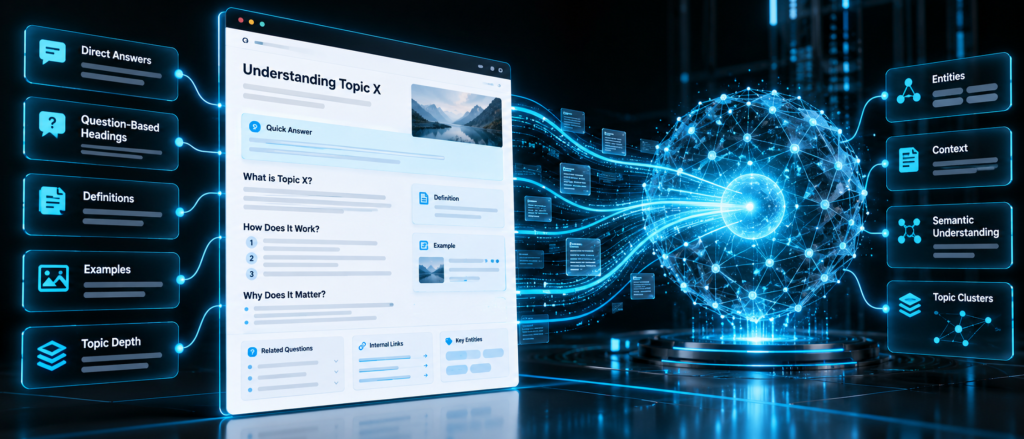
There is no guaranteed formula for getting an AI system to cite or recommend a particular page.
However, certain content characteristics make information easier to understand and extract.
1. Answer the Question Directly
Don’t make readers—or AI systems—search through five paragraphs before finding the answer.
Start important sections with a clear explanation.
For example:
What is automated lead nurturing?
Automated lead nurturing uses technology to deliver relevant follow-up based on a prospect’s behavior, interests, and stage in the buying journey.
The explanation can then go deeper.
This answer-first structure is useful for traditional readers, featured-answer formats, and AI-generated responses.
2. Use Clear Question-Based Headings
Questions naturally reflect how people search and interact with AI systems.
Instead of:
The Importance of Context
Consider:
Why Does Context Matter for LLM SEO?
Instead of:
Content Strategy
Consider:
What Content Works Best for LLM SEO?
The goal isn’t to turn every heading into a question.
Use question-based headings where they make the content easier to navigate and understand.
3. Define Important Concepts
Don’t assume readers already understand industry terminology.
Define terms such as:
- LLM SEO
- GEO
- Generative AI
- AI search
- Search intent
- Entities
- Topical authority
Clear definitions create stronger semantic context around the topic.
4. Build Topic Depth
One page rarely establishes expertise around an entire subject.
A stronger content ecosystem may include:
- Beginner guides
- Detailed how-to articles
- Comparisons
- FAQs
- Service pages
- Case studies
- Industry pages
- Original research
- Supporting resources
These pages can be connected through internal links to create a clearer topical structure.
5. Use Examples
Examples make abstract concepts easier to understand.
Instead of saying:
“Create contextually relevant content.”
Show what that means.
For example:
A CRM consulting company shouldn’t only publish a page called “CRM Consulting.”
It could also publish resources explaining CRM implementation, CRM migration, lead management, sales automation, CRM data quality, CRM integrations, reporting, and industry-specific CRM challenges.
That gives the business a much broader and more meaningful topical footprint.
What Types of Content Work Best for LLM SEO?
There is no single content format that guarantees AI visibility.
However, different formats serve different search and information needs.
Definitions
Useful for questions such as:
- What is LLM SEO?
- What is lead scoring?
- What is marketing automation?
How-to Guides
Useful when people need practical instructions or implementation advice.
Comparisons
Comparison content can answer questions such as:
- SEO vs GEO
- HubSpot vs Salesforce
- Marketing automation vs. lead nurturing
FAQs
FAQs provide concise answers to specific questions and can strengthen topical coverage.
Original Research
Research, statistics, surveys, and proprietary findings can provide information that other sources may reference.
Case Studies
Case studies demonstrate how concepts work in real situations and provide evidence of practical experience.
Service Pages
Well-written service pages can clearly establish what a company does, who it serves, what problems it solves, and how its approach works.
The strongest strategy is usually not choosing one format.
It is building a useful collection of content around the questions your audience actually asks.
How Do You Optimize a Website for LLM SEO?

LLM SEO isn’t limited to publishing blog posts.
Your entire website contributes to how clearly a business can be understood.
1. Build Clear Topic Clusters
Organize related content around important business topics.
For example, a digital marketing company might have a broader topic around CRM and supporting content covering:
- CRM implementation
- CRM migration
- CRM integrations
- Lead management
- Lead scoring
- Sales automation
- CRM reporting
- CRM strategy
Each piece should serve a useful purpose rather than exist simply to target another keyword.
2. Strengthen Internal Linking
Connect related pages naturally.
If an article discusses automated lead nurturing, it can link to relevant resources about:
- Marketing automation
- Lead scoring
- CRM
- Email marketing
- Customer journeys
Internal linking helps users discover related information while creating stronger relationships between topics.
3. Make Business Information Unambiguous
Your website should clearly communicate:
- Who you are
- What you do
- Where you operate
- Who you serve
- What services do you provide
- Which technologies do you specialize in
- What industries do you understand
- How can people contact you
Don’t make important business information difficult to interpret.
4. Use Structured Data Where Appropriate
Structured data can help search engines understand certain types of information on a website.
Depending on the content, this may include appropriate schema for:
- Organization
- Article
- Breadcrumbs
- FAQ
- Product
- Service
- Local business
Structured data should support real content rather than being used as a shortcut for creating visibility.
5. Keep Important Information Accessible
Your most important expertise shouldn’t exist only inside images, videos, or complex interactive elements.
If something matters to your audience, make the information available as clear, crawlable text where appropriate.
What Role Do Entities Play in LLM SEO?

An entity is a distinct, identifiable person, company, organization, product, place, concept, or other thing.
Entity clarity matters because businesses don’t exist as isolated keywords.
For example, Arissa International isn’t simply associated with the phrase “HubSpot consulting.”
It can be understood through relationships between concepts such as:
Arissa International → HubSpot → CRM → Marketing Automation → Sales → Digital Marketing → Custom Applications
A strong website makes these relationships clear through consistent content, terminology, internal linking, company information, and supporting resources.
The goal is to help both people and machines understand what the business is and what it is known for.
What Are the Common LLM SEO Mistakes?
LLM SEO is still developing, but several mistakes can weaken an AI search strategy.
Writing Only for Keywords
Repeating a keyword doesn’t establish expertise.
Modern content needs context, usefulness, and depth.
Publishing Generic AI-Generated Content
AI can accelerate content production, but generic content creates little differentiation.
Businesses still need original insights, experience, examples, data, and expertise.
Hiding the Answer
Long introductions can make useful information harder to find.
Answer the question first, then provide the explanation.
Creating Thin Topic Coverage
Publishing one article about a subject doesn’t establish meaningful expertise.
Build supporting content where it genuinely helps the audience.
Ignoring Brand Consistency
If your website, social profiles, business listings, and other public sources describe your company differently, your overall entity information becomes less clear.
Forgetting Human Readers
The goal isn’t to create content that sounds like it was written for an algorithm.
If people don’t find it useful, AI visibility alone won’t create a sustainable marketing strategy.
How Do You Measure LLM SEO Performance?

This is one of the biggest differences from traditional SEO.
Google rankings and organic traffic have established measurement methods.
AI visibility can be more difficult to measure because responses may vary based on:
- The AI system
- The user’s question
- Conversation history
- Location
- User context
- Available sources
- Model behavior
Businesses can still monitor useful signals.
AI Visibility
Check whether your company appears when relevant questions are asked across major AI search experiences.
Mentions and Citations
Track whether your business, website, or content is referenced as part of AI-generated answers.
Brand Searches
An increase in branded searches can indicate growing awareness after repeated exposure across search and AI experiences.
Qualified Traffic
Where referral data is available, examine whether AI-influenced visitors reach your website and engage meaningfully.
Leads and Conversions
Ultimately, visibility should contribute to business outcomes.
Track:
- Qualified leads
- Opportunities
- Sales conversations
- Conversion rates
- Revenue
The objective isn’t simply to be mentioned by AI.
It’s to be discovered by the right prospects and become a credible option when they’re ready to act.
Does Traditional SEO Still Matter for LLM SEO?
Yes.
LLM SEO should not be treated as a replacement for traditional SEO.
A strong strategy still benefits from:
- Technical SEO
- Search intent research
- Useful content
- Internal linking
- Website architecture
- Page experience
- Relevant authority signals
- Fresh and accurate information
The difference is that businesses now have another layer to consider:
Can search engines find and understand the content, and can AI systems understand and use it in the context of a user’s question?
The best approach is to build content that works for both.
How Can HubSpot Support an LLM SEO Strategy?
HubSpot does not automatically make a website optimized for LLMs.
But it can support the broader marketing system around your content and customer journey.
For example, HubSpot can help businesses manage:
- Contact and company data
- Lead capture
- Content interactions
- Email engagement
- Segmentation
- Lead nurturing
- Marketing automation
- Sales handoffs
- Campaign performance
- Reporting and attribution
This becomes valuable when LLM SEO is treated as part of a larger digital marketing strategy.
Your content attracts attention.
Your website provides information.
Your CRM captures and organizes engagement.
Marketing automation supports follow-up.
Sales receives context.
Reporting helps determine what is actually contributing to pipeline and revenue.
LLM SEO creates another discovery opportunity. It shouldn’t operate separately from the rest of the customer journey.
How Arissa International Helps Businesses Prepare for AI Search
LLM SEO works best when it is connected to a broader digital strategy.
At Arissa International, we help businesses strengthen the systems and content behind that strategy.
Our approach can include:
- SEO strategy: Identify the topics, questions, and search opportunities that matter to your audience.
- GEO and LLM SEO: Structure content to make expertise clearer and more useful for AI-driven discovery.
- Website optimization: Improve information architecture, content structure, internal linking, and conversion paths.
- Content strategy: Build useful content around customer questions rather than publishing disconnected keyword-targeted articles.
- HubSpot implementation: Connect marketing, CRM, sales, automation, and reporting.
- Digital marketing: Turn visibility into meaningful engagement and qualified opportunities.
- Conversion optimization: Make it easier for prospects who discover your business to take the next step.
The objective isn’t to chase every new AI platform.
It’s to build a digital presence that is clear, credible, connected, and useful.
The Takeaway
LLM SEO is changing the way businesses should think about online visibility.
The question is no longer only:
“How do I rank for this keyword?”
It is also:
“Does my content clearly demonstrate what I know, what I do, and why it matters to the person asking the question?”
Businesses that invest in useful content, strong topical coverage, clear entities, structured information, internal linking, and genuine expertise will be better positioned for an increasingly AI-driven search environment.
You don’t need to write for machines.
You need to make your expertise easier for machines—and people—to understand.
Frequently Asked Questions (FAQs)
LLM SEO is the practice of optimizing website content and information so that large language models can better understand a business, its expertise, and the topics it covers.
No. The terms overlap significantly. LLM SEO generally focuses on making information understandable and usable by large language models, while GEO focuses more specifically on visibility within AI-generated and generative search experiences.
LLM SEO uses clear content, strong topical coverage, contextual information, entity clarity, internal linking, structured information, and credible expertise to make a website easier for AI systems to interpret.
Start by clearly explaining what your business does, who it serves, and what it knows. Then build useful topic clusters, answer customer questions directly, strengthen internal links, maintain consistent business information, and use appropriate structured data.
Yes. Traditional SEO remains an important foundation. LLM SEO extends that foundation by considering how AI systems understand and use website information.
AI can help with research, outlining, drafting, and content production. However, publishing generic AI-generated content without original expertise or meaningful value is unlikely to create strong differentiation.
Useful formats include definitions, how-to guides, comparisons, FAQs, original research, case studies, industry resources, and detailed service pages. The best content directly addresses questions and provides meaningful expertise.
Measurement can include AI mentions, citations, AI-driven visibility, branded searches, referral traffic where measurable, qualified leads, opportunities, and conversions.
LLM SEO can improve how clearly your business and content are represented to AI systems, but there is no guaranteed method for making a business appear in a particular ChatGPT response.
Start with the basics: identify the questions your customers ask, create authoritative answers, organize related content into clear topics, strengthen internal linking, clarify your business information, and connect content performance to business outcomes.