

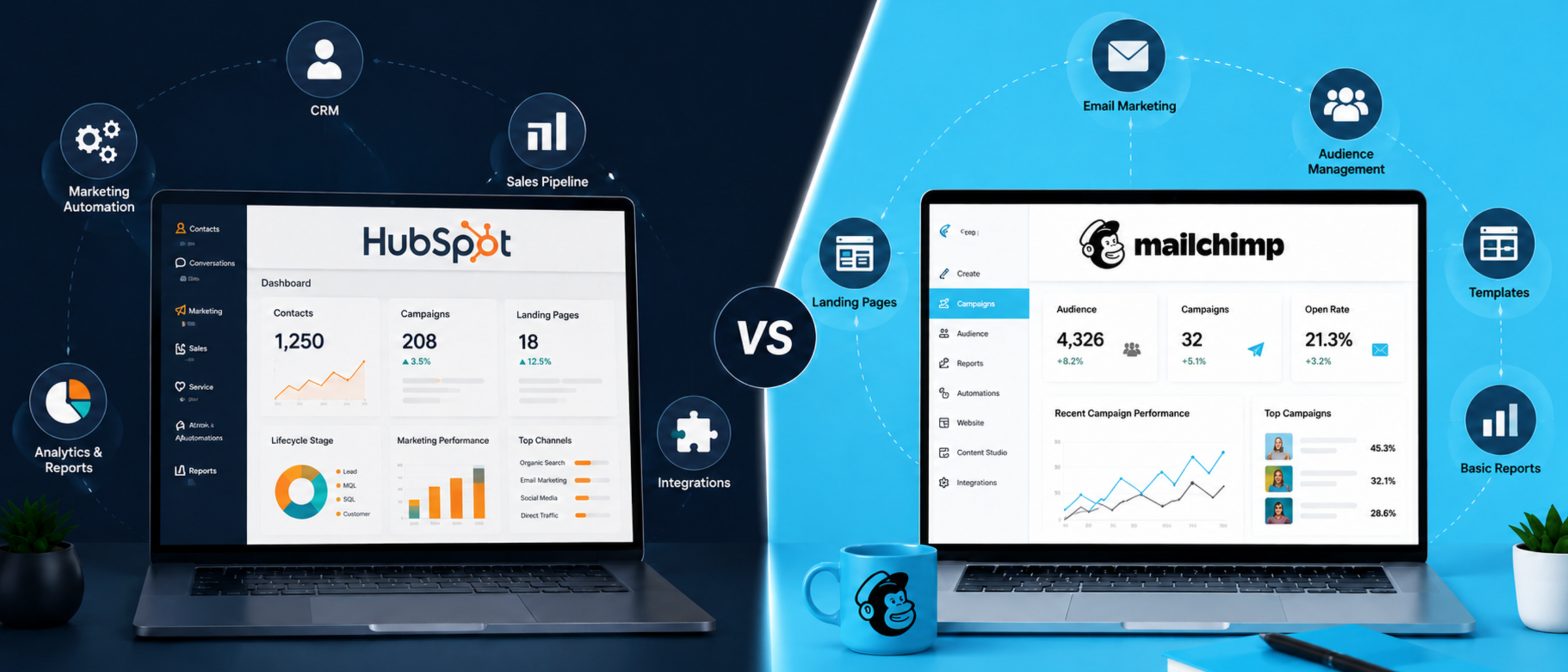
Choosing the right marketing platform is a critical decision for businesses aiming to scale efficiently, engage customers, and improve marketing ROI. With increasing competition and digital complexity, companies need tools that not only execute campaigns but also automate, provide clarity, and deliver measurable outcomes.
Among the most widely used platforms, HubSpot and Mailchimp stand out for their marketing capabilities. However, they differ significantly in scope, functionality, and scalability.
Understanding these differences is essential to selecting a platform that aligns with your business goals and growth strategy.
Understanding HubSpot and Mailchimp
Before comparing features, it is important to understand how each platform is positioned. While both support marketing, their capabilities and use cases differ.
HubSpot – An All-in-One Growth Platform
HubSpot is a comprehensive platform that unifies marketing, sales, and customer service operations. It enables businesses to manage the entire customer lifecycle, from awareness to retention, within a single system.
Its built-in CRM allows teams to track interactions, manage pipelines, and align marketing with sales. This centralized approach ensures customer data is accessible and actionable across teams.
HubSpot also offers advanced automation, enabling workflows based on real-time user behavior. Its CMS, blogging tools, and analytics help businesses create, manage, and optimize campaigns effectively.
HubSpot is best suited for organizations looking for a scalable, integrated solution that supports long-term growth.
Mailchimp – A Focused Email Marketing Platform
Mailchimp is widely known for its email marketing capabilities and ease of use. It allows businesses to design, send, and analyze campaigns without requiring advanced technical expertise.
Its drag-and-drop editor and template library simplify email creation, while audience segmentation enables targeted communication based on behavior and preferences. This helps improve engagement and campaign performance. Businesses can track performance using metrics such as open rates and click-through rates to optimize campaigns.
Mailchimp also supports basic automation, including email sequences and triggered workflows, making it easier to maintain consistent communication.
While it has expanded beyond email, Mailchimp remains most effective for businesses that prioritize email marketing as their primary channel.
HubSpot vs Mailchimp: Key Differences
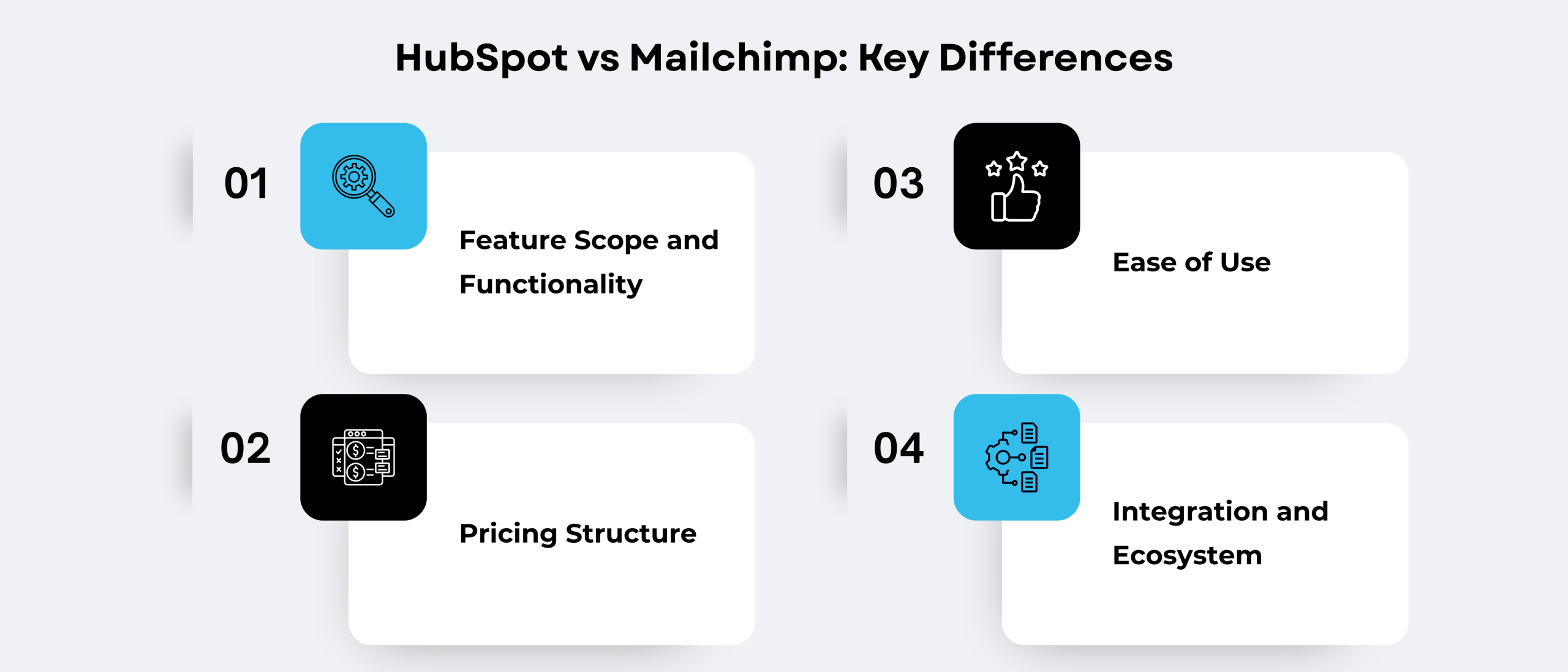
When evaluating HubSpot vs Mailchimp, businesses must consider how each platform supports their current needs and future growth. The differences between HubSpot and Mailchimp become more evident when comparing their core capabilities.
Feature Scope and Functionality
- HubSpot: Offers a complete suite including CRM, marketing automation, sales tools, customer service features, and analytics in one platform.
- Mailchimp: Focuses mainly on email marketing, with additional but limited features for automation and campaign management.
HubSpot’s broader functionality makes it suitable for managing complex customer journeys, while Mailchimp is more focused on campaign execution.
Pricing Structure
- HubSpot: Provides a free tier for basic tools, with scalable pricing based on features and business requirements.
- Mailchimp: Offers a free plan for email marketing, with paid tiers depending on subscriber count and advanced features.
While both platforms provide entry-level access, HubSpot’s pricing reflects its wider capabilities and long-term scalability.
Ease of Use
- HubSpot: Designed with a user-friendly interface despite its extensive capabilities, making it accessible for growing teams.
- Mailchimp: Known for simplicity and quick setup, particularly for email campaigns.
Mailchimp may be easier for beginners, while HubSpot offers structured usability for more advanced operations.
Integration and Ecosystem
- HubSpot: Offers a broad ecosystem with integrations across CRM systems, analytics tools, e-commerce platforms, and more.
- Mailchimp: Supports integrations with popular tools but has a comparatively limited ecosystem.
A stronger integration network allows HubSpot to support more complex workflows and data synchronization.
HubSpot vs Mailchimp: Which Marketing Platform Is Right for Your Business?
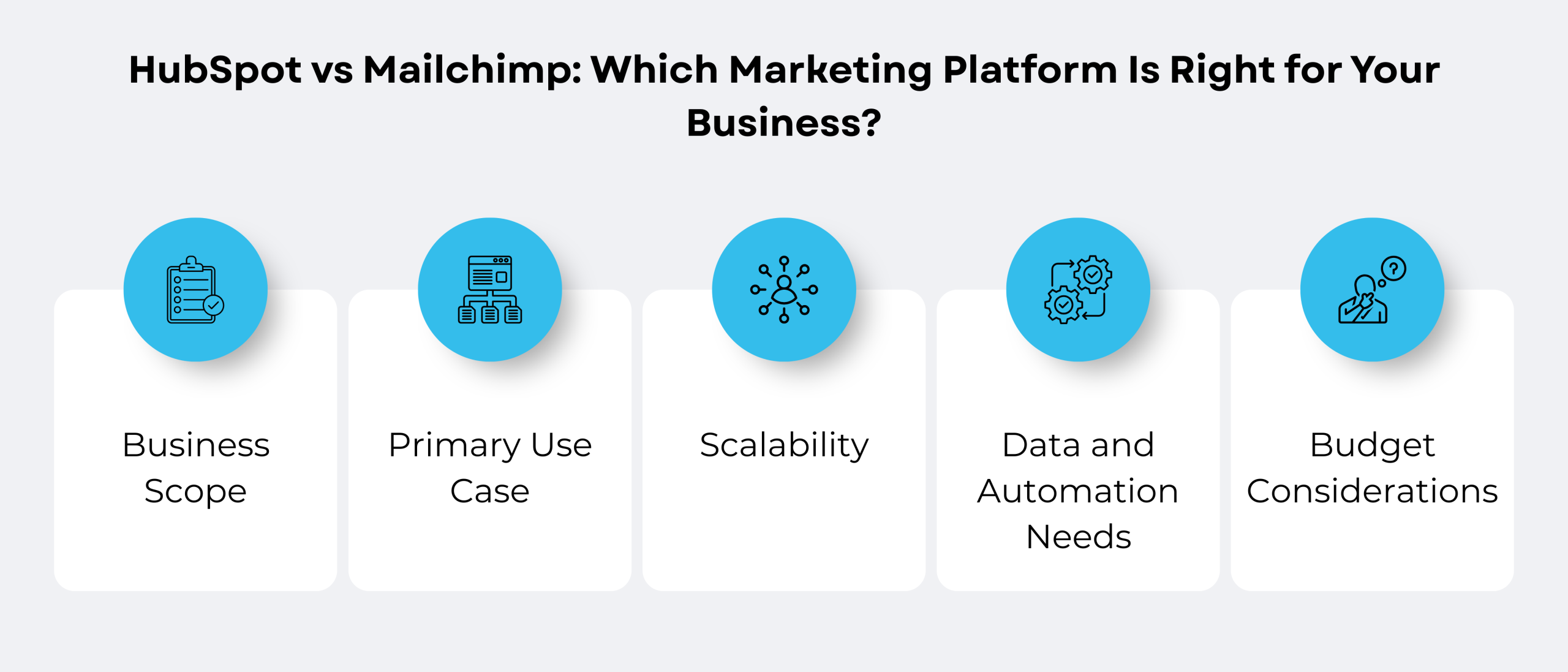
Selecting the right platform depends on your business objectives, internal capabilities, and long-term vision. Rather than focusing solely on features, it is important to evaluate how the platform will support your overall marketing strategy.
Consider the following factors:
- Business Scope: Organizations with multi-channel strategies and sales alignment requirements benefit more from HubSpot’s all-in-one capabilities.
- Primary Use Case: Businesses focused mainly on email marketing may find Mailchimp sufficient for their needs.
- Scalability: HubSpot provides greater flexibility for scaling operations as business complexity increases.
- Data and Automation Needs: Advanced automation and centralized data management are better supported by HubSpot.
- Budget Considerations: Mailchimp may be more cost-effective for smaller teams, while HubSpot offers higher long-term value for growing businesses.
Ultimately, the decision should be based on how well the platform aligns with your growth strategy rather than immediate convenience.
Making the Right Marketing Platform Decision
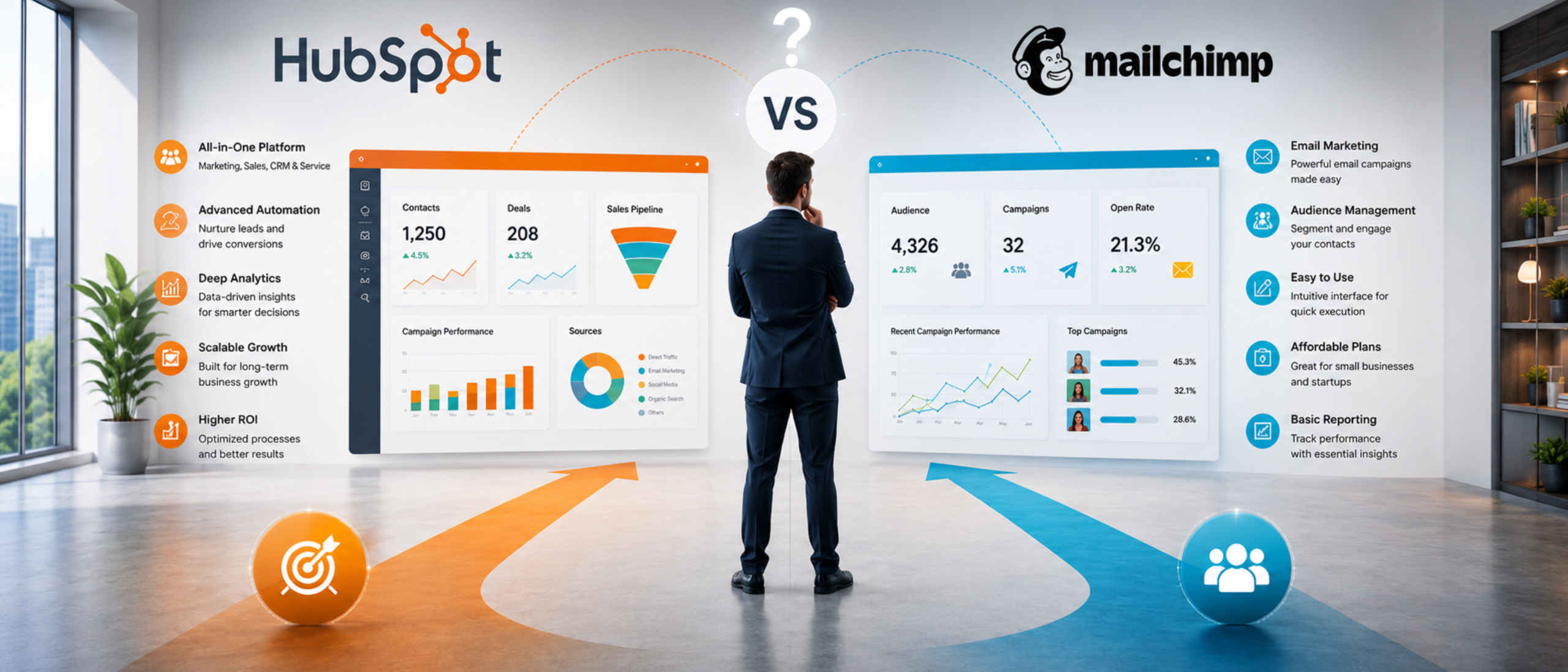
Choosing between HubSpot and Mailchimp is not about selecting the “better” tool, but the right one for your business context.
HubSpot is ideal for businesses seeking an integrated system that supports long-term growth, operational efficiency, and data-driven decision-making. Mailchimp is better suited for businesses focused on email marketing and straightforward campaign execution.
Both platforms offer value, but their effectiveness depends on alignment with your processes, team capabilities, and growth goals.
Arissa International helps businesses make well-informed decisions, based on clear objectives, execution capability, and marketing maturity, ultimately resulting in engagement, efficiency, and ROI over time.
Frequently Asked Questions (FAQs)
Mailchimp is often preferred by small businesses focused on email marketing due to its simplicity and lower cost. HubSpot becomes more valuable as businesses scale.
No, Mailchimp lacks the comprehensive CRM, sales, and service capabilities offered by HubSpot.
Yes, for businesses seeking long-term growth, automation, and alignment across teams.
Yes, but it may create isolated data sets if not managed properly.
Yes, Arissa International helps businesses evaluate and implement marketing platforms based on their goals.